
(Originally published on 2025-08-19; last reviewed on 2025-08-19; last updated on 2025-08-19)
(Note: This article is a companion to my unofficial Magic: The Gathering—FINAL FANTASY update bulletin. I decided to publish them simultaneously, which delayed them by one or two weeks, in addition to all the delay caused by Gatherer 2.0. As a result, some information in this article became outdated while I was still writing it. Recording the history of Magic’s rules system is one of the primary goals of my blog, so I decided to leave this article as an account of the historical state of Gatherer 2.0, rather than incorporate the new information. That will get an article of its own.)
- The rollout
- Card sets
- Oracle entries
- The first look
- Printed text over Oracle text
- What happened to all the reminder text?
- The look and accessibility of symbols
- Rebalanced costs
- Accessibility of color indicators
- Rebalanced battles
- Rebalanced vanguard cards
- Goodbye mana values, watermarks, and community content
- Multi-component cards
- Acceptance of acorn cards
- Version-specific rulings
- Searching for cards
- Conclusion
At the start of June, Wizards of the Coast (WotC) made an unexpected announcement: a redesign of Gatherer, their searchable Oracle card reference and source of all official Oracle text. The content of the announcement is as follows (minus the preview screenshots):
For more than two decades, Gatherer has been the go-to for players looking up card text, judges checking Oracle updates, and Vorthoses chasing down every mention of Squee.
Now, it’s getting an update!
Over the coming weeks, you may notice some visual changes to Gatherer as you browse your favorite cards, search for obscure combos, or dive into Magic‘s deep card history. This update is all about making Gatherer feel cleaner, more modern, and easier to use—whether you’re on desktop, a tablet, or your phone. We will be phasing this update, so some of you will see the new version while others may see the old Gatherer look as we roll these changes out.
It is also just the first step in a series of improvements we’ll be delivering throughout the year. But more on that later. For now, we hope you enjoy the refreshed look.
A Fresh Look for Gatherer
The old version of Gatherer (Gatherer 1.x from now on) was not amazing, but it largely fulfilled what I consider its primary purpose: providing official Oracle text. I had been quite content with Gatherer 1.x and its technical structure, so upon reading WotC’s announcement, I worried that the new Gatherer (Gatherer 2.0 from now on) might be a downgrade for my use cases.
That Gatherer 2.0 would necessitate a major restructuring of my archival code was a certainty, but after merely seven weeks of nonstop work, my archiving workflow has been mostly restored to its Gatherer 1.x level.
As far as features are concerned, my worries were entirely unfounded. Gatherer 2.0 is overflowing with amazing features and design decisions, a true testament to WotC’s mastery at creating high-quality digital experiences. It shows that, even after 30 years, WotC can still innovate and make bold design decisions to raise their flagship product to the next level.
My article tries to relate all these pinnacles of website design, but I fear mere words will be insufficient to do them justice; one has to experience it firsthand to truly believe it, so I encourage all readers to visit Gatherer 2.0 themselves and check out everything WotC did to make it “feel cleaner, more modern, and easier to use.”
Before I start in earnest: customers in general and Magic fans in particular like to complain, but they seldom give praise. So, if you find Gatherer 2.0 and its current state just as fabulous as I do, be sure to contact your favorite WotC employee and kindly ask them to forward your compliments to the right people.
The rollout
WotC posted the announcement on June 2nd. The next morning, I visited Gatherer and was greeted by an unexpected sight.
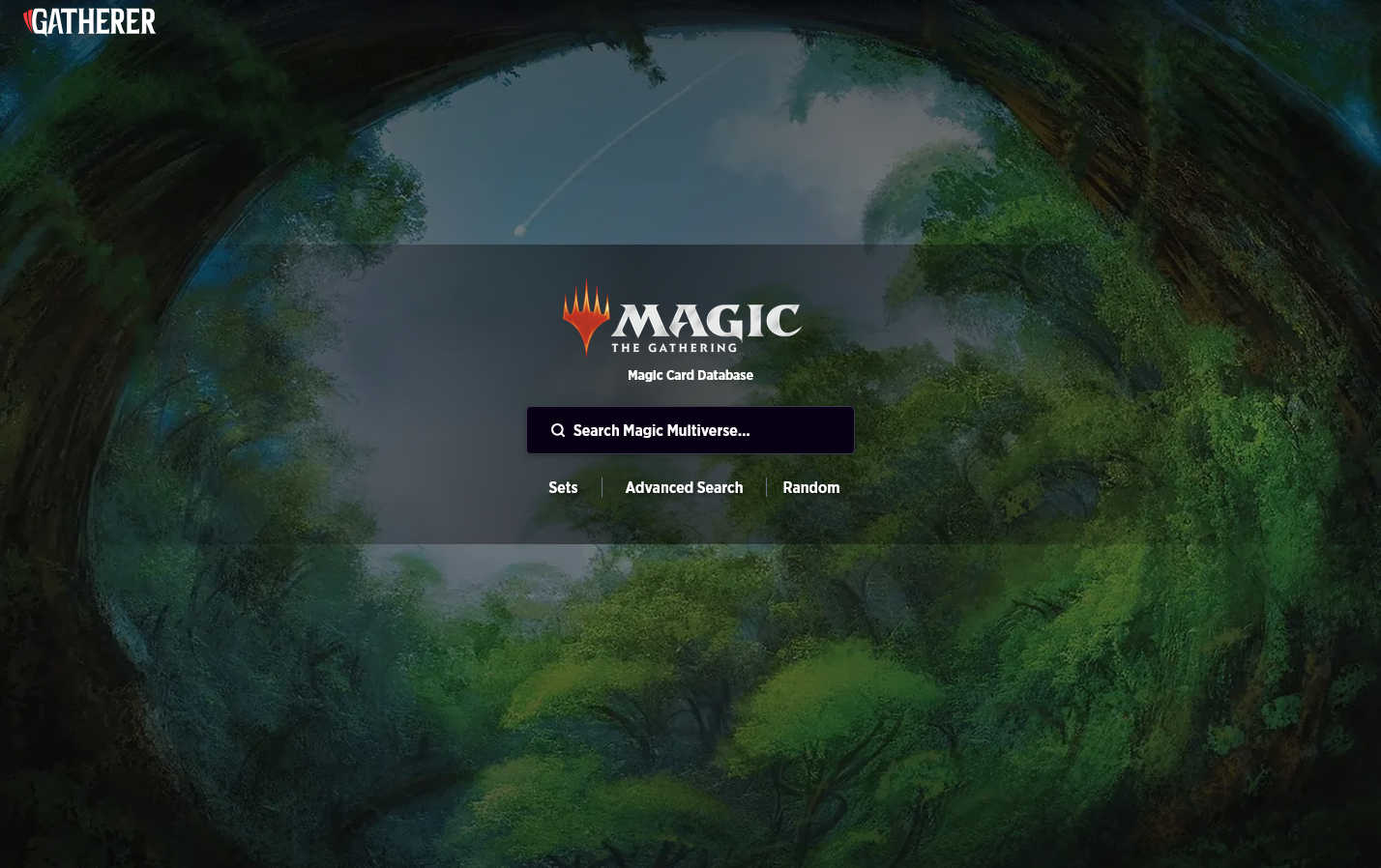
Was this the new Gatherer I had been promised the day before? I vaguely remembered the announcement saying Gatherer 2.0 would roll out “over the coming weeks”—in corporate speak, this seems to mean “in about twelve hours.” Some experimentation showed that I could still access Gatherer 1.x by clearing my browser’s cookies; the next visit would result in Gatherer 1.x or 2.0, apparently chosen at random. Not perfect, but I had a way of visiting both Gatherer versions.
This lasted less than five days. On the morning of June 7th, I found myself unable to reach Gatherer 1.x. After more than two dozen attempts, I concluded that this “phased update” “over the coming weeks” had been completed—in less than five days. On a positive note, this shows WotC’s continued commitment to speed and reliability whenever it concerns shutting down parts of their website. It could also mean that WotC has developed new processes to speed up their work; if a weeks-long rollout can be completed in five days without any drop in quality, why not shorten things like set development in a similar way? Just imagine the increase in awesome new card sets we could expect to see each year.
Card sets
The first thing to catch my eye on the new home page was “Sets.” This seemed new. After two clicks, I arrived at a table with card sets. Presumably, these were all the card sets found on Gatherer 2.0.
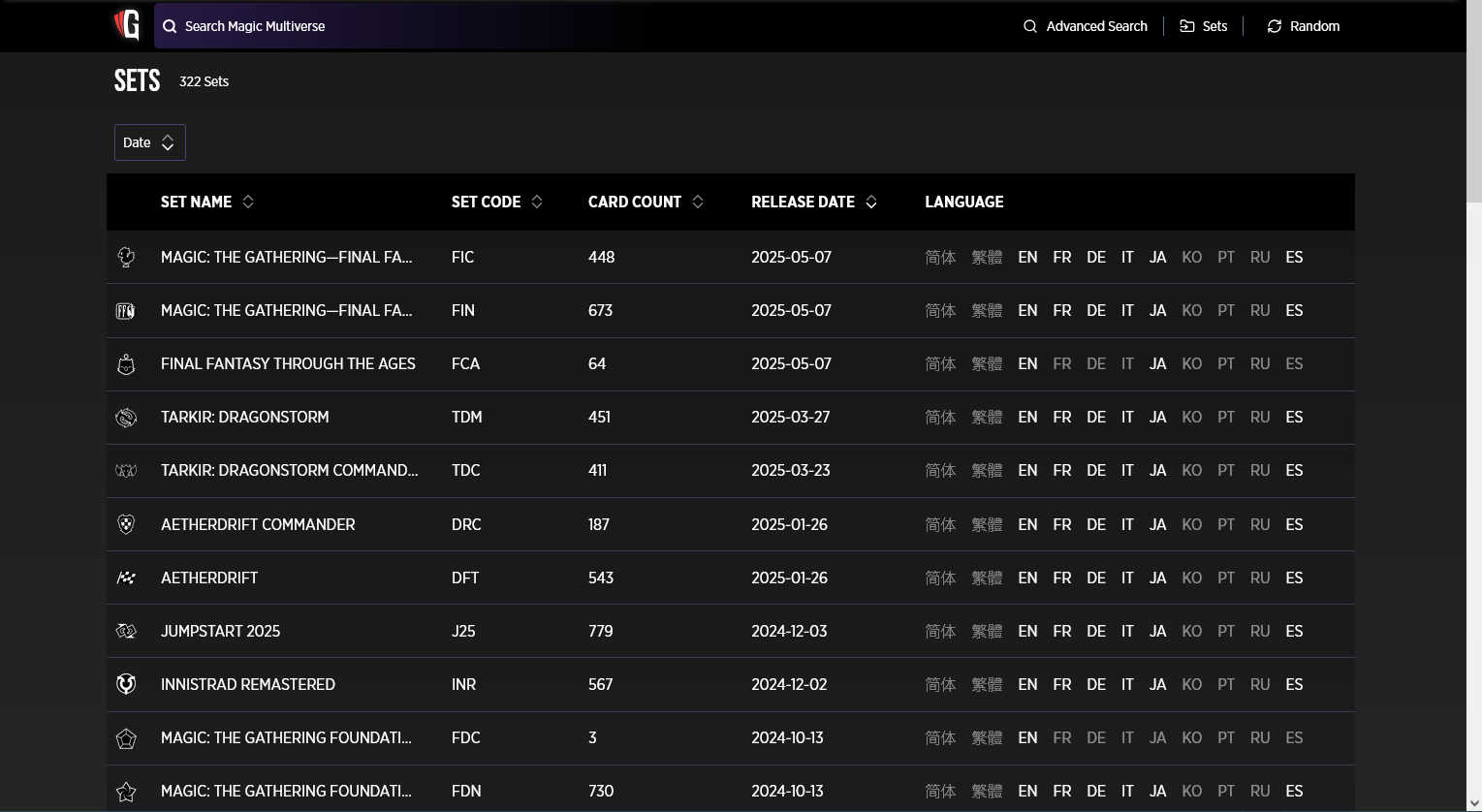
What a delightful new feature. In addition to each set’s name, it lists a bunch of useful information, such as the set’s symbol and code, its size (labeled “card count”), its release date, and the languages it was printed in. So, if you ever want to compare set sizes or release dates, this is the place to go.
Set sizes
For the “card count” column, you just have to remember that Gatherer 2.0 counts Oracle entries, not cards. In other words, cards with two or more “components,” such as split cards, double-faced cards, adventurer cards, or omen cards, are counted that many times. Also, Gatherer 2.0 counts each version of a card, so if a card got printed in a normal version, an extended-art version, and a showcase version, the count increases by 3.
Also, you have to remember which specific Booster Fun treatments are found on Gatherer 2.0 for each set. For the first few sets, such as Throne of Eldraine and Ikoria: Lair of Behemoths, Gatherer 2.0 does not contain any Booster Fun treatments at all. Other sets do have treatments, but not all of them; my rule of thumb is that each “visually distinctive” version appears only once. For example, Omo, Queen of Vesuva from Modern Horizons 3 Commander has four versions on Gatherer 2.0: normal, borderless profile, etched foil, and extended art. The ripple-foil versions do not appear, since they look the same as the non-ripple-foil ones.1
This is just a rule of thumb, though, so be sure to memorize the exact structure of each set; for example, Magic: The Gathering—FINAL FANTASY breaks this rule by having each version of each card appear on Gatherer 2.0. Just keep all of this in mind and comparing set sizes on Gatherer 2.0 becomes the easiest thing in the world.
Release dates
The release dates are even more straightforward to use. What is interesting about this column is the amount of release dates I had remembered incorrectly. Right out of the gate, Magic: The Gathering—FINAL FANTASY is listed as having been released on May 7th, while I would have placed its release on June 13th.
Going further down the list, Innistrad Remastered and Magic: The Gathering Foundations were also released a month earlier than I remembered; Modern Horizons 3 and Modern Horizons 3 Commander were released almost a month apart; The Lord of the Rings: Tales of Middle Earth released in October 2023, four months after the prerelease tournaments2; Unfinity (acorn), the non-tournament-legal part of Unfinity, released in September of 2022, while the tournament-legal part had released earlier that year in March; Ixalan released between Amonkhet and Hour of Devastation; Mirrodin Besieged released a whole year earlier than I had thought; and most astonishing of all, Coldsnap released a full decade earlier.
I guess this shows just how much brain damage one can sustain by constantly thinking about Magic’s rules system. I am thankful that WotC added this information to Gatherer 2.0, so that misinformed or misremembering persons such as I can finally correct their beliefs. I also expect wiki maintainers to be overjoyed by this influx of new information and the sheer number of wiki pages that will get corrected with that information.
Languages
What at first looked like the languages a set has been printed in is actually just the list of languages available on Gatherer. The column is labeled just “languages,” so that’s my fault for assuming.
My opinion
According to the announcement, “this update is all about making Gatherer feel cleaner, more modern, and easier to use,” and this first new feature certainly delivers.
Gatherer 1.x did not feature release dates at all, and there was no handy table of card sets. If I wanted to compare card sets by sizes or look up their languages, I had to make individual search queries for each set and look at individual Oracle entries. Now, all of this is bundled in a sortable, searchable table. Looking up release dates of card sets also becomes much faster, since they are all in the same place. Full marks on the “ease of use” part.
Also full marks on the “modern” part. These days, such trivial information as the algorithm behind the card counts or the languages does not need to be displayed to the user. Gatherer visitors are experienced at navigating the web and can quickly discern the way these numbers work; they also have memorized double-faced cards etc., as well as all the different Booster Fun treatments for each set, so they can easily adjust the displayed card counts in their head for different use cases.
Retired card sets
Another thing I noticed while looking through the card set table is that three sets are missing. These sets are Tarkir: Dragonstorm Tokens, Tarkir: Dragonstorm Commander Tokens, and Promo set for Gatherer. The first two had been brand new and contained entries for the token helper cards released in Tarkir: Dragonstorm and Tarkir: Dragonstorm Commander. Promo set for Gatherer was a collection of twenty-one early Prerelease promo cards, the Dragon Con promo card Nalathni Dragon, and the five HarperPrism promo cards. Of those last five, Sewers of Estark and Windseeker Centaur have never been reprinted and thus have no more Oracle entry and no more Oracle text, which makes them practically unplayable in all formats.
Interestingly, if I visit the URL of a corresponding Gatherer 1.x entry, I get redirected to a Gatherer 2.0 URL whose structure matches that of other Oracle entry URLs. The URL even includes a PPR set code which could reasonably stand for Promo set for Gatherer. This suggests that Promo set for Gatherer could still exist somewhere in the underlying database, and that the software built on top of it might simply ignore it, making the set invisible to the user. Since Gatherer 2.0 is the only publicly available source of official Oracle text, the end result is the same.
My opinion: This one gets another thumbs up for ease of use. If Gatherer doesn’t show me Oracle entries for these cards, I don’t need to use it, and not using Gatherer is by definition the easiest way to use it. No more Oracle text also means not having to remember it, so the game of Magic has become easier for everyone.
Also thumbs up for giving Gatherer 2.0 a modern look and feel. Companies abruptly shutting down servers or deleting information from their websites is certainly a modern trend, especially if this makes their customers unable to continue using the products they bought from those companies. Alternatively, organizations denying access to information that should be publicly available is also a modern trend, so no matter the actual cause for those missing Oracle entries, WotC have all the bases covered.
Oracle entries
After the card sets, I looked at some Oracle entries.
The first look
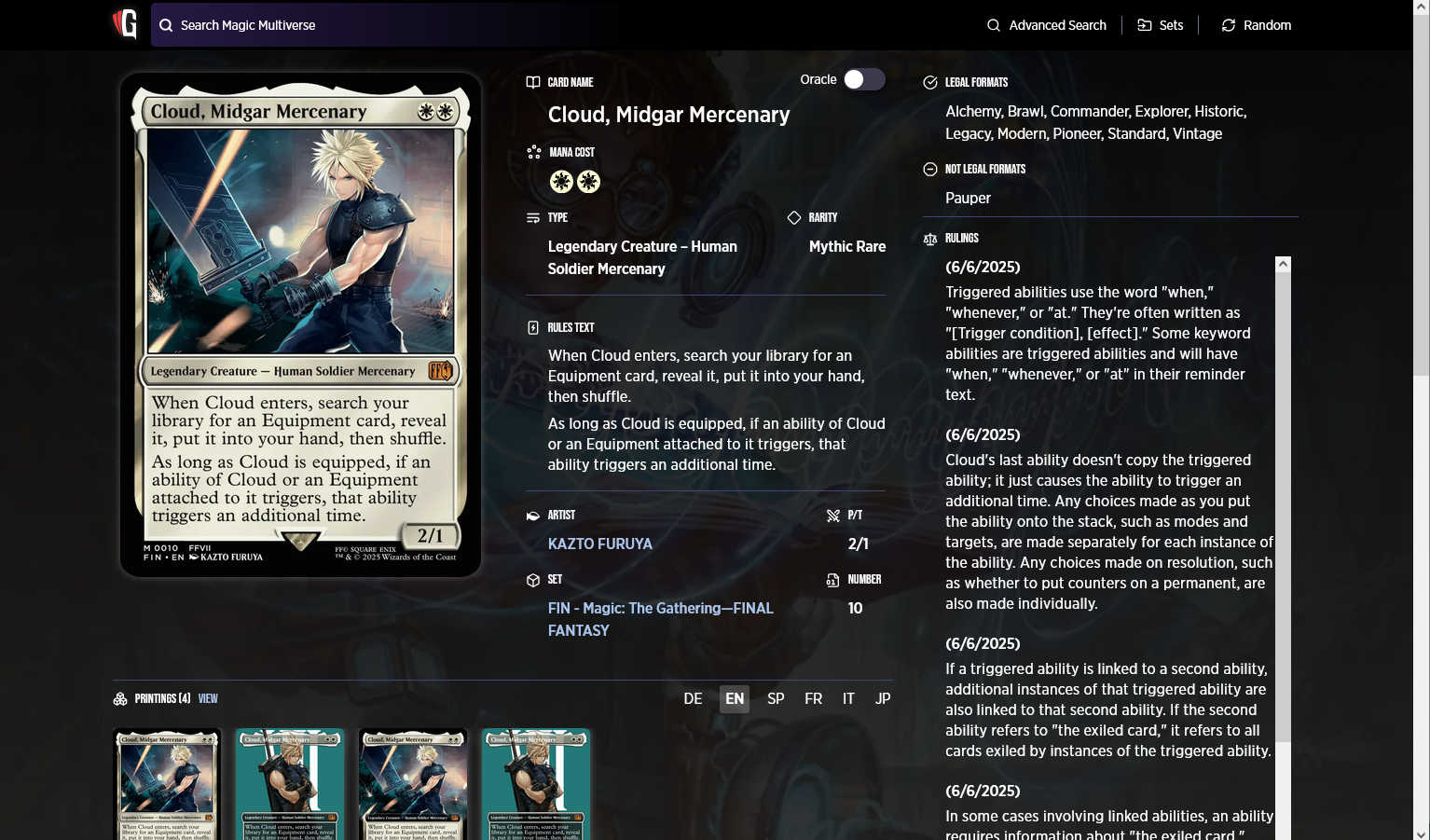
That looks okay. The card image has become larger, compared to Gatherer 1.x. Name, mana cost, and all the other parts of the Oracle text are accounted for. There are little symbols before the individual fields, which is a nice touch. At the right-hand side, I find different formats and Cloud’s legality in each of them, as well as the Gatherer rulings which used to be below the Oracle text. That space is now filled by small images of all the different versions/printings of Cloud.
What’s gone are the community ratings and comments. Both functionalities had been broken for about a decade, but existing ratings and comments had still been available. Now, they are nowhere to be found.
My opinions: Points again for ease of use. In Gatherer 1.x, the format legalities and the list of printings were each on a separate page; now, all the information is displayed on a single page and I don’t need to switch between them.
The icons support the modern look, so points for that, too. The deleted community ratings and comments are another fine implementation of the information erasure trends I mentioned under retired card sets, so more points for a modern look and feel.
Printed text over Oracle text
On a second look, you may notice that the “Oracle” slider in the top right corner of the Oracle text section is switched off, meaning that the displayed information is the printed text of Cloud, and not its Oracle text. This was the default setting.
My opinion: What a brilliant idea. I cannot count the number of times that I visited Gatherer 1.x to check for the printed text of a card: I would go to the entry page, my eyes were immediately drawn to the exciting white-on-black text, and only while reading it did I realize that this was the Oracle text. That’s not at all what I wanted! I then had to switch the tab to the printed text or move my eyes all the way over to the bland full-color card image to find the text I was actually looking for.
Now, I am automatically greeted by the printed text each time I visit an Oracle entry page. And in the super rare cases where I actually want to look at an Oracle text, it’s just a click away. Even better, the setting is not kept from page to page and always starts at off—after all, who would want to look at more than one Oracle text per Gatherer visit? It’s even in the announcement article: “looking up card text,” “checking Oracle updates,” and “chasing down every mention of Squee.” No mention of “Oracle text” at all.
Alas, this great new feature was short-lived. A month after launch, an update made “Oracle text” the default setting. I have to assume that some higher-up manager noticed what the development team had done and—lacking their vision—ordered them to go back to the bizarre world of “Oracle text first.” Still, one has to applaud the development team for coming up with such a brilliant idea in the first place.
What happened to all the reminder text?
Onward to another card.
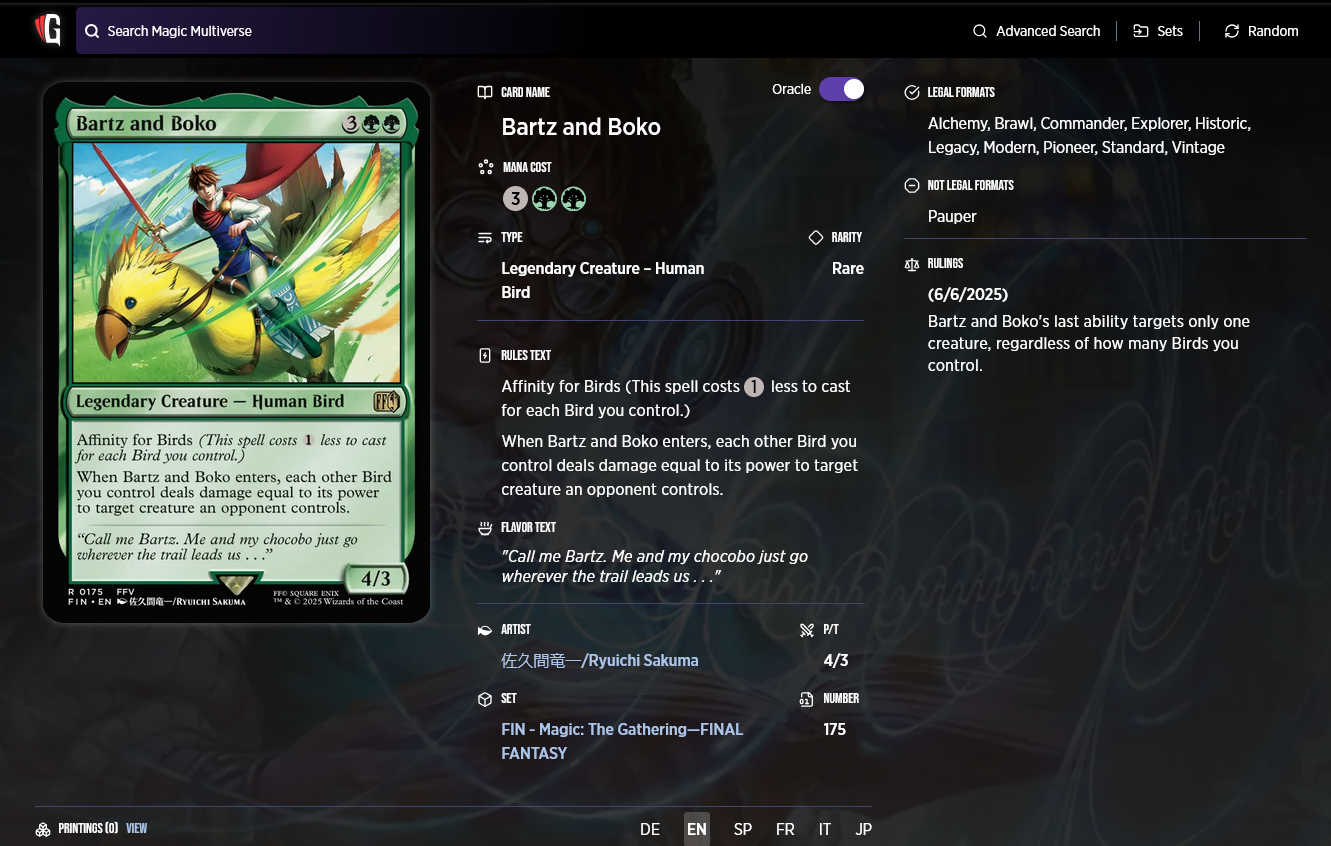
The next thing I want to mention is that the reminder text looks different. It is not italicized anymore. Which means that it’s now rules text rather than reminder text. That’s correct: WotC updated the rules text of over 9,000 cards and replaced their reminder text with identically worded rules text.
My opinion: Another great idea by WotC. Larger formats often get stale after a while, but printing new cards powerful enough to change the metagame without breaking it proves to be difficult. Handing out errata to thousands of cards makes it more likely that multiple decks will profit, thus reducing the risk of a single all-star warping a format around itself. In addition, many players will already own these cards, thus reducing their need to shell out for yet another set of brand new cards from a premium product. Rebalanced cards are already a staple of MTG Arena; this is merely the next step.
Last but not least, this should cause people to stop accusing WotC of “dumbing down” the game. Removing all existing reminder text and simultaneously shaking up all formats at once certainly shows a commitment to higher-complexity gameplay.
The look and accessibility of symbols
Looking at Bartz and Boko’s Oracle entry, one may also notice that the generic mana symbols in the mana cost and the reminder rules text look a bit unusual. My own thought upon first seeing these symbols was “These look like cheap knockoffs” and this is probably a part of why WotC chose this implementation.
Counterfeits are no joke and it is in WotC’s interest that the Magic community is ever vigilant about this threat to the game. And what better way to raise awareness of the issue than to deliberately make mana symbols on Gatherer look like amateur fakes. Each time I visit Gatherer 2.0, these symbols catch my attention anew, so if this was WotC’s goal, they did a fabulous job.
Another reason I can think of is that WotC want to encourage more fan content. There are probably many people in the Magic community who would like to express their passion for the game in a creative way, but feel intimidated by the (usually) high quality of WotC’s graphic design. What better way to encourage these fans than by deliberately using mismatched mana symbols on your own website. If WotC are proud enough of such a design to display it on the premier “go-to for players looking up card text, judges checking Oracle updates, and Vorthoses chasing down every mention of Squee,” then no fan should be ashamed of their own creation.
The technical reason for why these symbols look so different is that Gatherer 2.0 does not use embedded images for its symbols. Gatherer 1.x used <img /> elements to insert premade images of mana and other symbols into the text of the webpage; Gatherer 2.0 uses <svg> elements which paint the symbols themselves.
For the green mana symbol {G}, the <svg> element paints two shapes: a green circle and a black tree on top of the circle. Similar shapes are drawn for most of the other symbols and they look just like the symbols printed on cards (except they are totally flat with no shadow). A notable exception is the colorless mana symbol {C}, whose diamond shape is much larger than the version printed on cards.
For the numeric mana symbols and the variable symbol {X}, only the gray circle is drawn. The number or the “X” are not images, they are actual characters. As such, they are rendered using the same font as the rest of the mana symbol field or the rules text field, which is not the font used for printed cards. Even better, the mana cost field and the rules text field have different styles. This allows for three different versions of such a mana symbol, as seen on the page for Armillary Sphere: the mana symbol in the mana cost field looks different from the symbol in the rules text field, and both look different from the symbols seen on the card image.
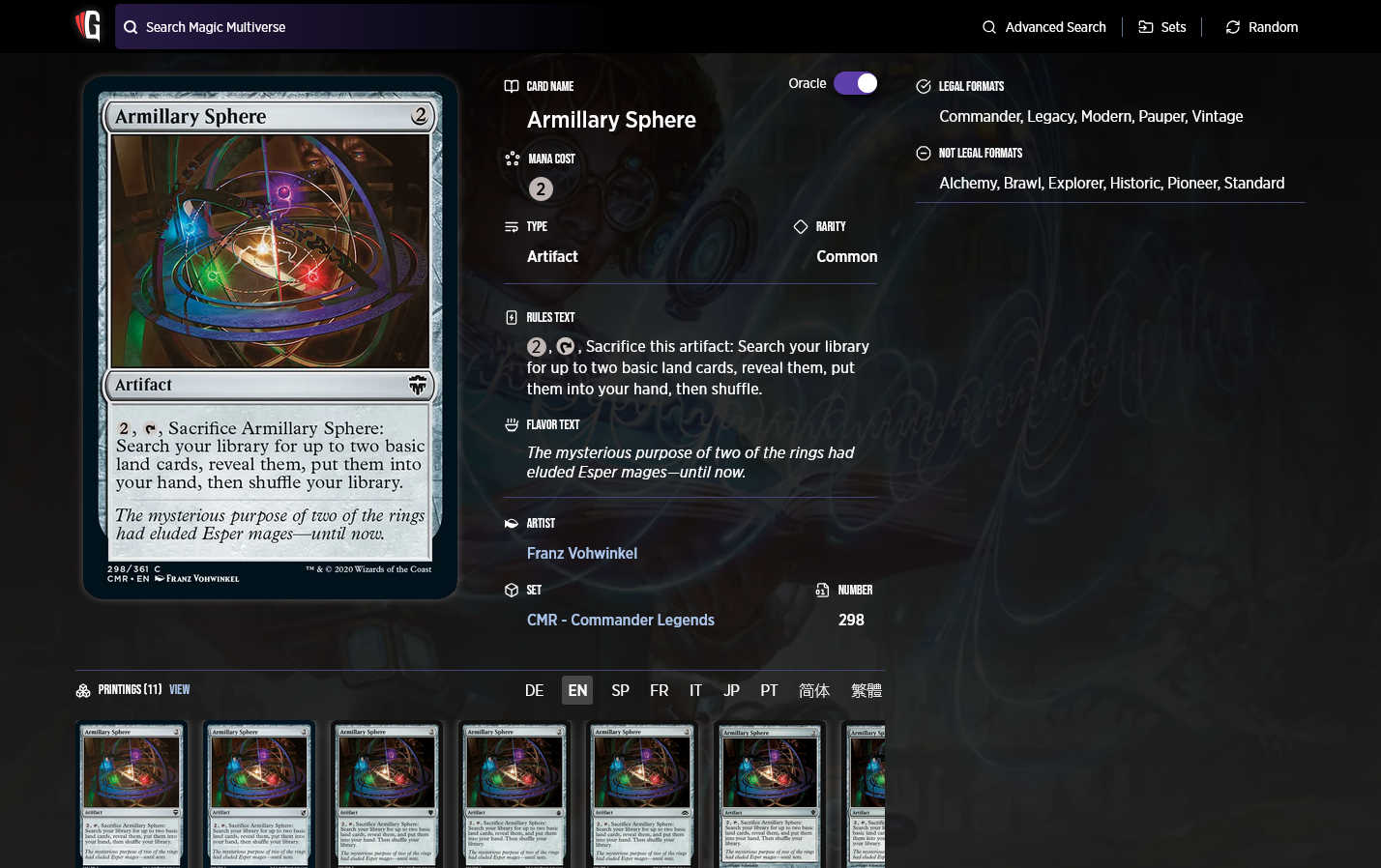
<svg> elements have some advantages and disadvantages compared to <img /> elements. One advantage is that SVGs can scale in size without loss of quality. The images used by Gatherer 1.x did not have a super high resolution, while the SVGs used by Gatherer 2.0 always look crisp. Perhaps the Gatherer development team simply chose to use <svg> elements because they didn’t have access to high-resolution images of Magic symbols. After all, where would they even get such a thing? It’s not like these images grow on trees.
Another difference is that <svg> elements are less accessible than <img /> elements, or at least harder to make accessible (as far as I was able to research). The <svg> elements used by Gatherer 2.0 have no accessibility features at all, or if so, I was unable to find them in the HTML source code or with Firefox’s accessibility inspector. My attempts to read symbols in mana costs or rules text with Window’s built-in screen reader also failed; tests with archived Gatherer 1.x pages and their <img /> elements, on the other hand, succeeded.
Thus, my conclusion is that Oracle text on Gatherer 2.0 is not accessible to people with a visual impairment or anyone else relying on a screen reader. WotC are usually on the side of more accessibility and they have improved the accessibility of Gatherer in other places (see accessibility of color indicators below); in certain parts of the world, however, there is also a recent trend of reversing accessibility efforts, so maybe this is just part of making Gatherer “more modern.”
Finally, one should remember that Gatherer is much like a buffet. Just ignore the parts you don’t like or are allergic to (like cards with colored mana symbols on them) and focus on the parts you can and do enjoy (like colorless artifacts, artist names, and flavor text).
Rebalanced costs
Totally unrelated to the new implementation of symbols, WotC also rebalanced a few cards with very expensive costs. For example, the last ability of Realmbreaker, the Invasion Tree, used to cost the hefty sum of {10}, effectively preventing it from ever seeing tournament play.
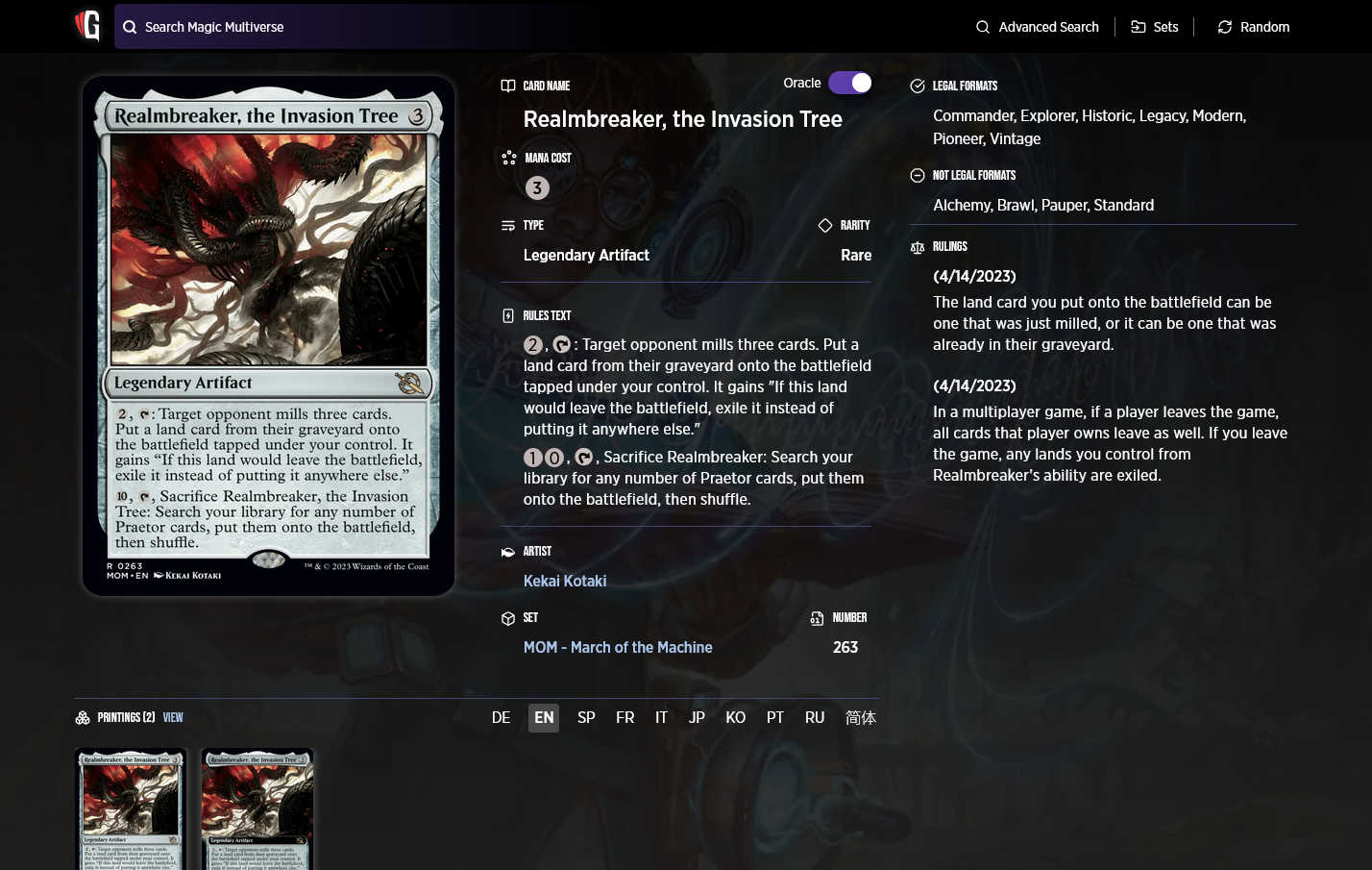
Now, it costs a measly {1}, turning Realmbreaker into a key card for dumping a ton of Praetors onto the battlefield as early as turn four. I look forward to seeing Turbo Praetors at the next big Standard tournament.
Accessibility of color indicators
Color indicators are a long-standing accessibility issue. They rely entirely on color, so people with color blindness have a hard time identifying them. Personally, I also find the rare three-colored indicators hard to recognize at a glance, and often need to take a closer look to be certain of their exact colors.
Just last month, a WotC employee reaffirmed that WotC are trying to solve the issue, but that it’s not an easy one. His information seems to be out of date, though, because as part of Gatherer 2.0, WotC implemented a solution to make color indicators accessible to everyone. Take a look at the Oracle entry for Insectile Aberration:
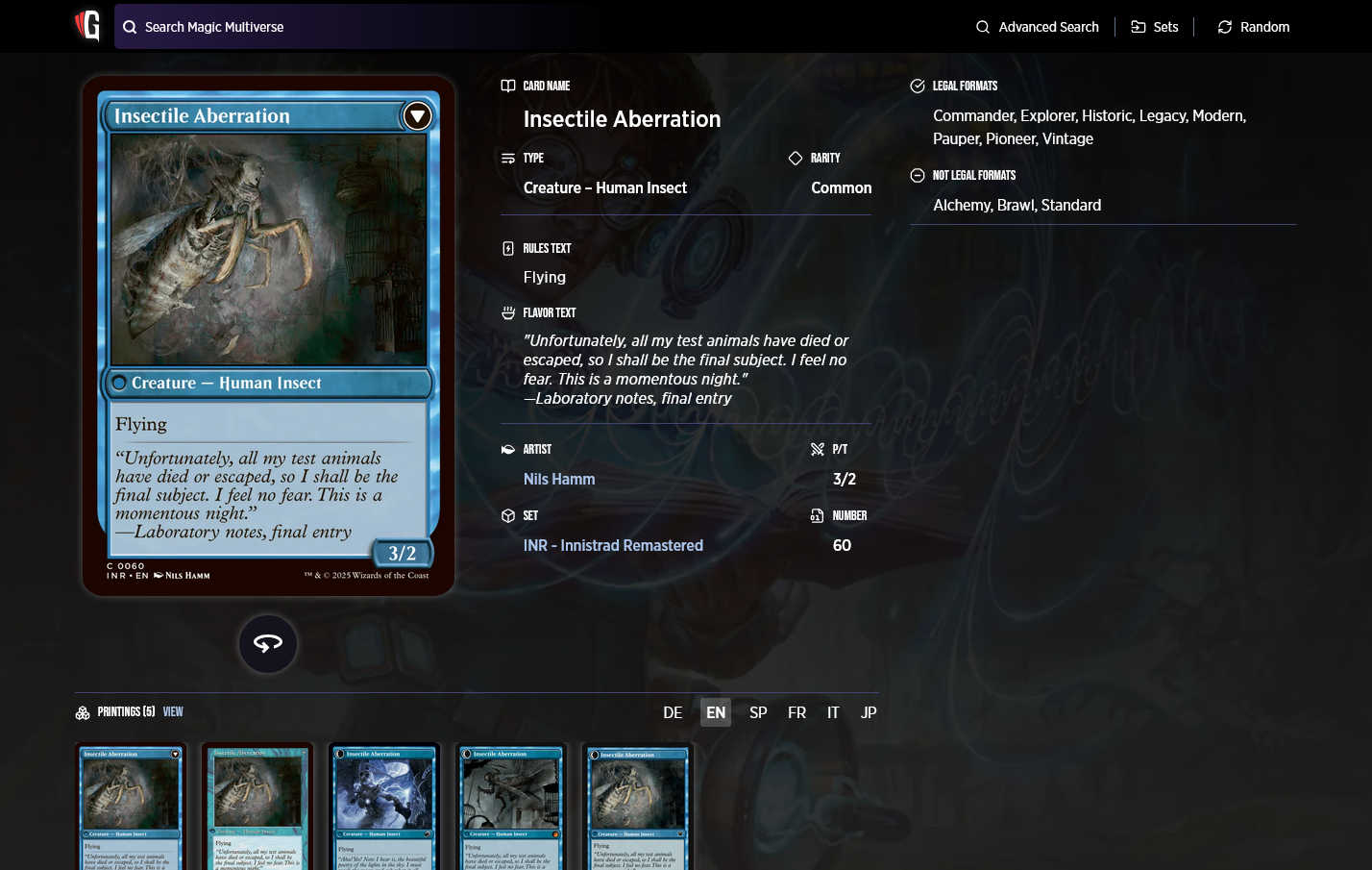
You may notice that the page does not list a color indicator. That’s right, WotC’s solution was simply to remove the color indicators of all existing cards. Without those color indicators, anyone can easily recognize the color of such a card (or card face): it doesn’t have one. All these cards are now colorless. Insectile Aberration? Colorless. Ancestral Vision? Colorless. Living End? Colorless. Crashing Footfalls? Colorless. Sephiroth, One-Winged Angel? Colorless.
Besides making these cards more accessible, this update also encourages brewers across all formats to reevaluate these cards, as well as cards that care about color. Consign to Memory becomes even more versatile. Garruk Relentless can now be played in a mono-green Commander deck. The sky is the limit.
My opinion: Full points for improving accessibility, and it makes Gatherer 2.0 feel more modern. This change also improves ease of use in general: if there are no color indicators to look up, I need to use Gatherer less often and the indicators no longer occupy precious brain space.
Rebalanced battles
WotC’s next rebalancing applies to the battles from March of the Machine. These cards have dominated multiple formats for more than two years now, and the time has come to let other cards shine. Instead of outright banning those cards though, WotC opted for a power-level errata.
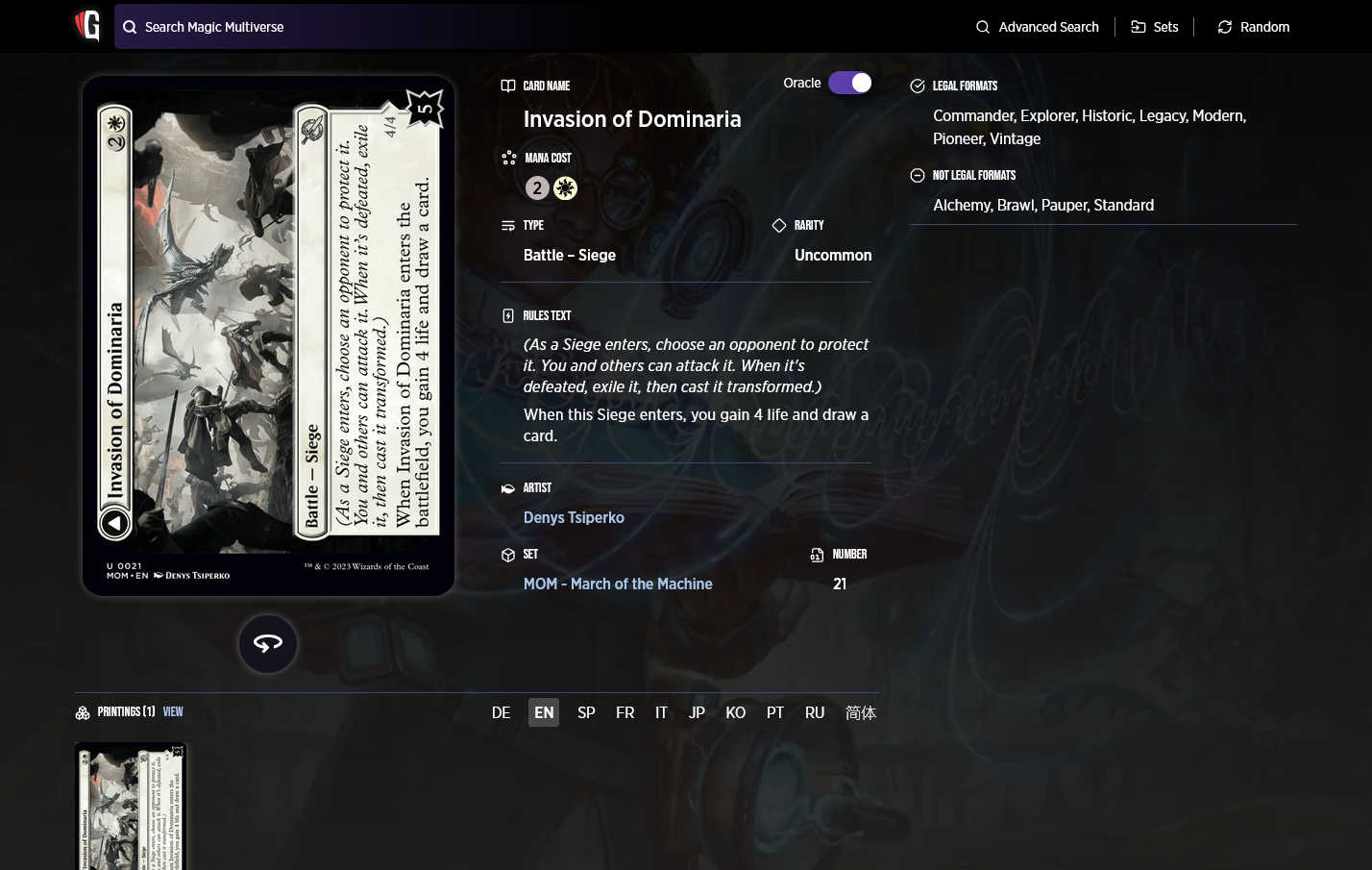
As with the previous screenshot, you may notice that a certain characteristic is nowhere to be seen. Simultaneously with the release of Gatherer 2.0, WotC rebalanced all existing battles by removing their defense values. Without that value, a battle enters without defense counters and is immediately put into the graveyard. This makes battles useless for most purposes, but a specialized deck caring about card types in the graveyard or in exile, for example, can still utilize them.
Rebalanced vanguard cards
In the Vanguard variant, each player uses a vanguard card which modifies the player’s hand size and starting life total, and grants them access to a special ability. This variant had originally been designed for casual play, but in recent years, competitive Vanguard play (often shortened to cVanguard) has become quite popular, with tournaments attracting large numbers of players.
Unfortunately, the casual roots of the format cause some tournament issues. First, WotC did not playtest vanguard cards as rigorously as other cards. Second, the sheer number of different modifier combinations causes a larger number of rules and policy infractions, especially for players coming from other formats and for players who often switch between different vanguard cards. Changing between hand modifiers leads to more Mulligan Procedure Errors, as players draw an incorrect number of cards at the start of a game. Life modifiers cause more Communication Policy Violations, as players write down and communicate incorrect (starting) life totals.
As part of their efforts to support cVanguard, WotC have issued power-level errata for all one hundred and seven vanguard cards.
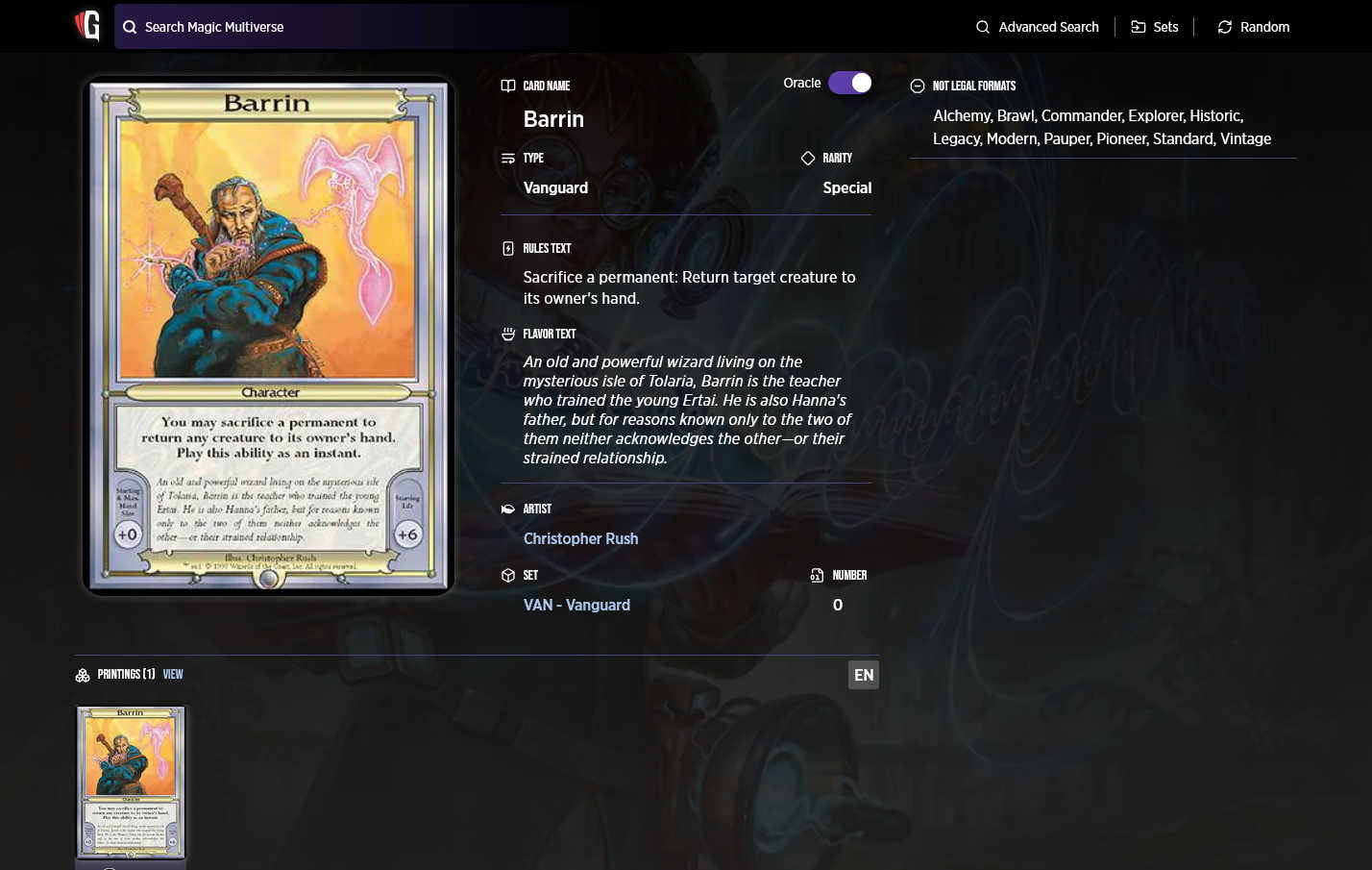
Similar to battles, WotC have removed the hand and life modifiers of all vanguard cards, effectively making them all +0/+0. This will certainly cut down on the number of infractions, so I expect this change to be especially popular among judges. Without modifiers, players need to care only about the cards’ abilities, which will make the format more beginner-friendly.
Goodbye mana values, watermarks, and community content
Along with all these power-level errata, WotC also got rid of some nonfunctional fields that cluttered up Gatherer’s user interface. Mana values, watermarks, and community ratings and comments are no longer displayed in Gatherer 2.0.
My opinion: I am sad at losing the community ratings and all the insightful comments, and feel indifferent about the watermarks, but I do welcome the removal of the mana value field. Calculating the mana value of most objects requires nothing more than elementary school math, and with this move, WotC demonstrate their faith in the mathematical abilities of the Magic community. Also, in the rare case where the mana value does not simply reflect the mana cost (i.e., double-faced cards), Gatherer 1.x systematically displayed incorrect values for a whole group of cards. If the options are a) correct but trivial information mixed with nontrivial incorrect information, or b) no information at all, I prefer the latter one.
Multi-component cards
One of the design issues any Oracle card reference must face is the handling of multi-component cards. By this I mean split cards, flip cards, double-faced cards, adventurer cards, and omen cards: cards that have two or more alternative sets of characteristics. How does Gatherer 2.0 deal with these cards?
When I search for “Lovestruck Beast” on Gatherer 2.0, I am greeted with this:
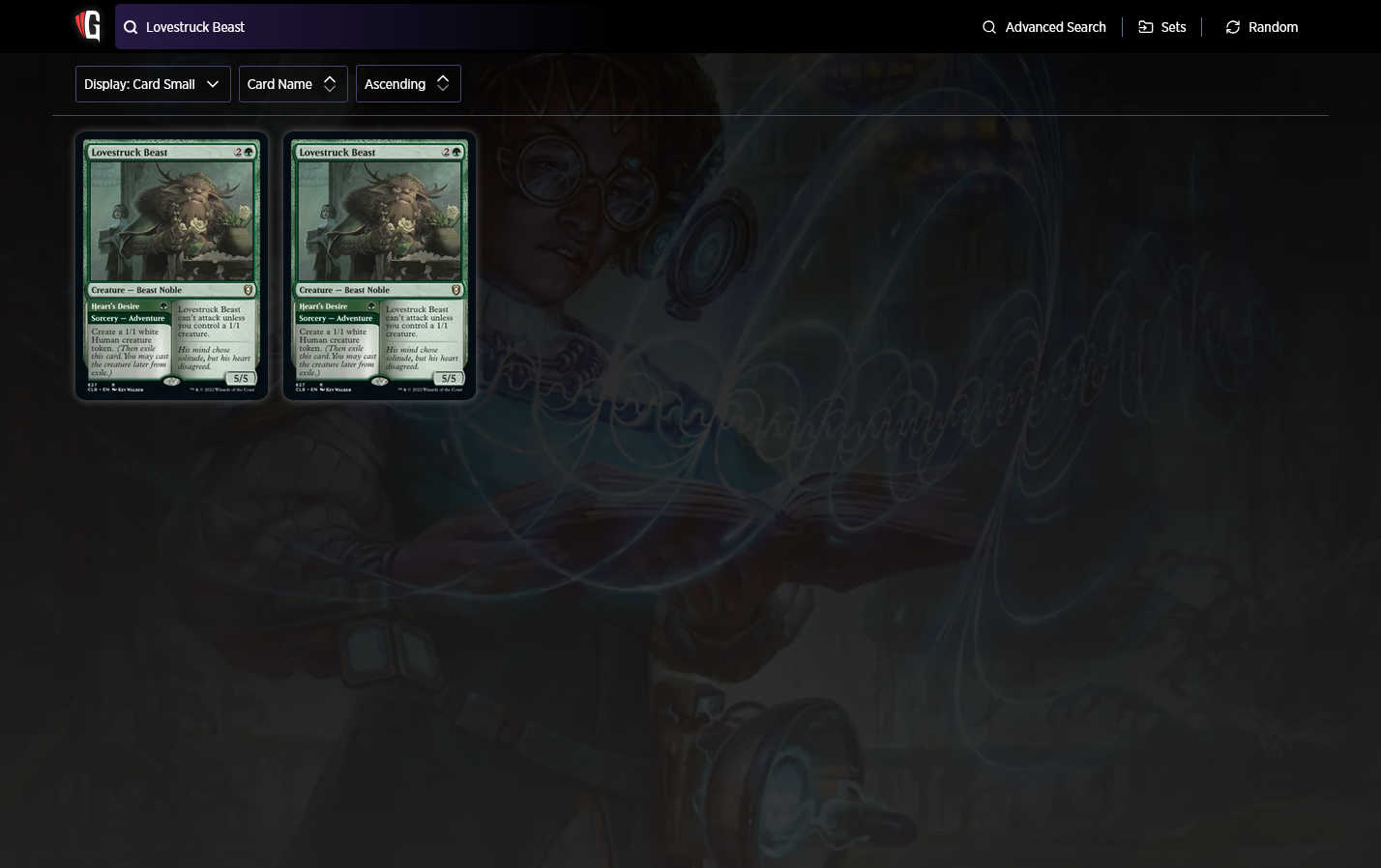
Two identically looking results with no further explanation. Why are there two results and which of them is the one I am looking for? Does it even matter? I could find out where each result leads to by hovering over the card images with my mouse and glancing at the URL at the bottom of the browser window, but that seems like cheating; also, mobile users are rumored to exist, and they don’t have it as easy. So I will just go with the information the result page shows me.
When I click on the first image, I get to an Oracle entry page. The page title and the printed card name say it’s for Lovestruck Beast; the URL and the Oracle card name say it’s for the card’s Adventure, Heart’s Desire. The mana cost matches Heart’s Desire, but the type line and the rules text match neither component because both are blank.
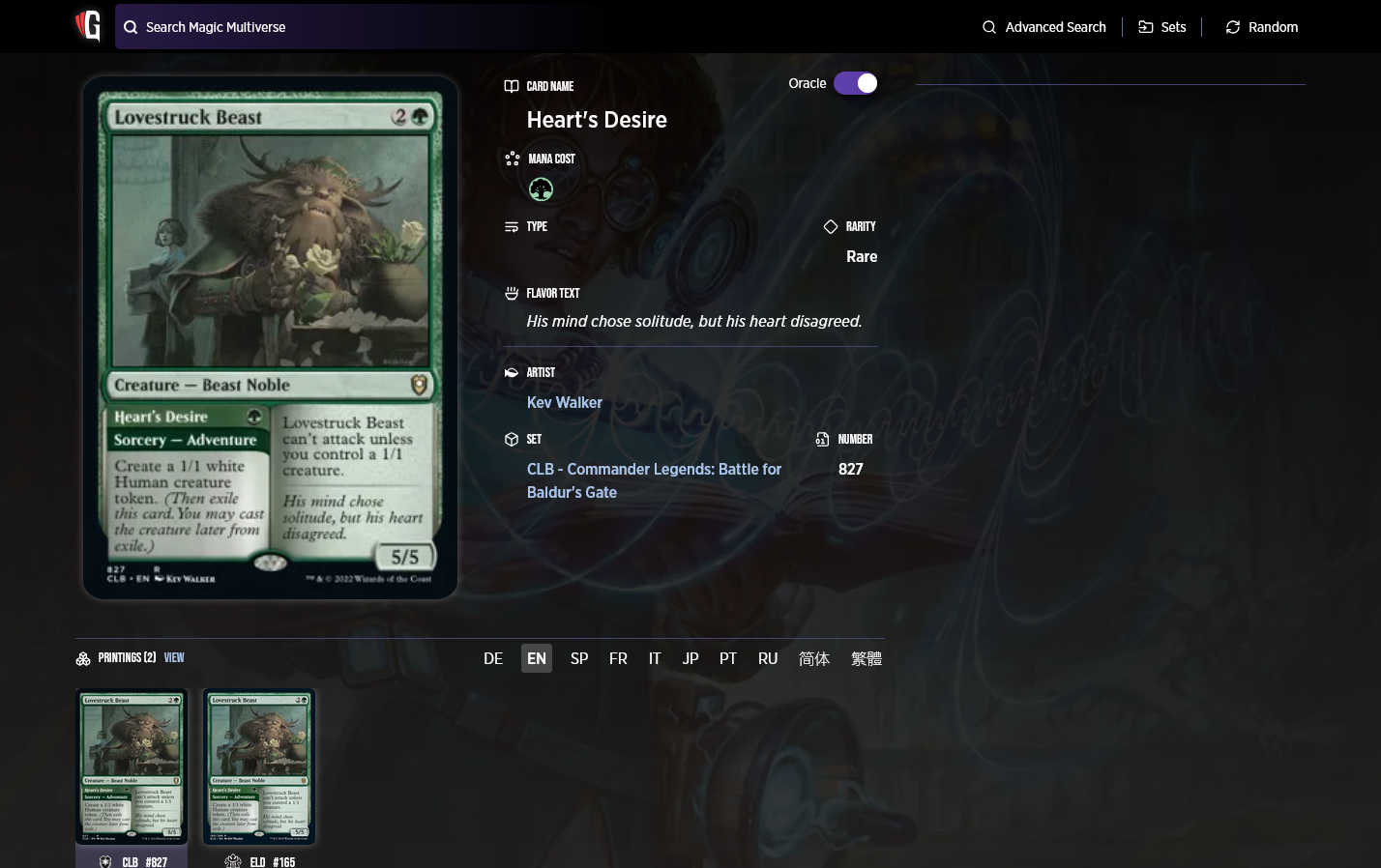
At this point, I lean toward this being an Oracle entry for Heart’s Desire. Its purpose is a bit unclear to me, since the parts of the Oracle text that are most likely to change and therefore the most relevant (supertypes, types, subtypes, and rules text) are left blank.
When I go back to the result page and click on the other card image, I get to another Oracle entry page. This time, everything proclaims this to be for Lovestruck Beast; the type line matches expectations, and the rules text, in addition to Lovestruck Beast’s own, contains the complete text of Heart’s Desire. My conclusion is that this is the Oracle entry for the card Lovestruck Beast: it provides the Oracle text of both the main component, as well as the Adventure component.
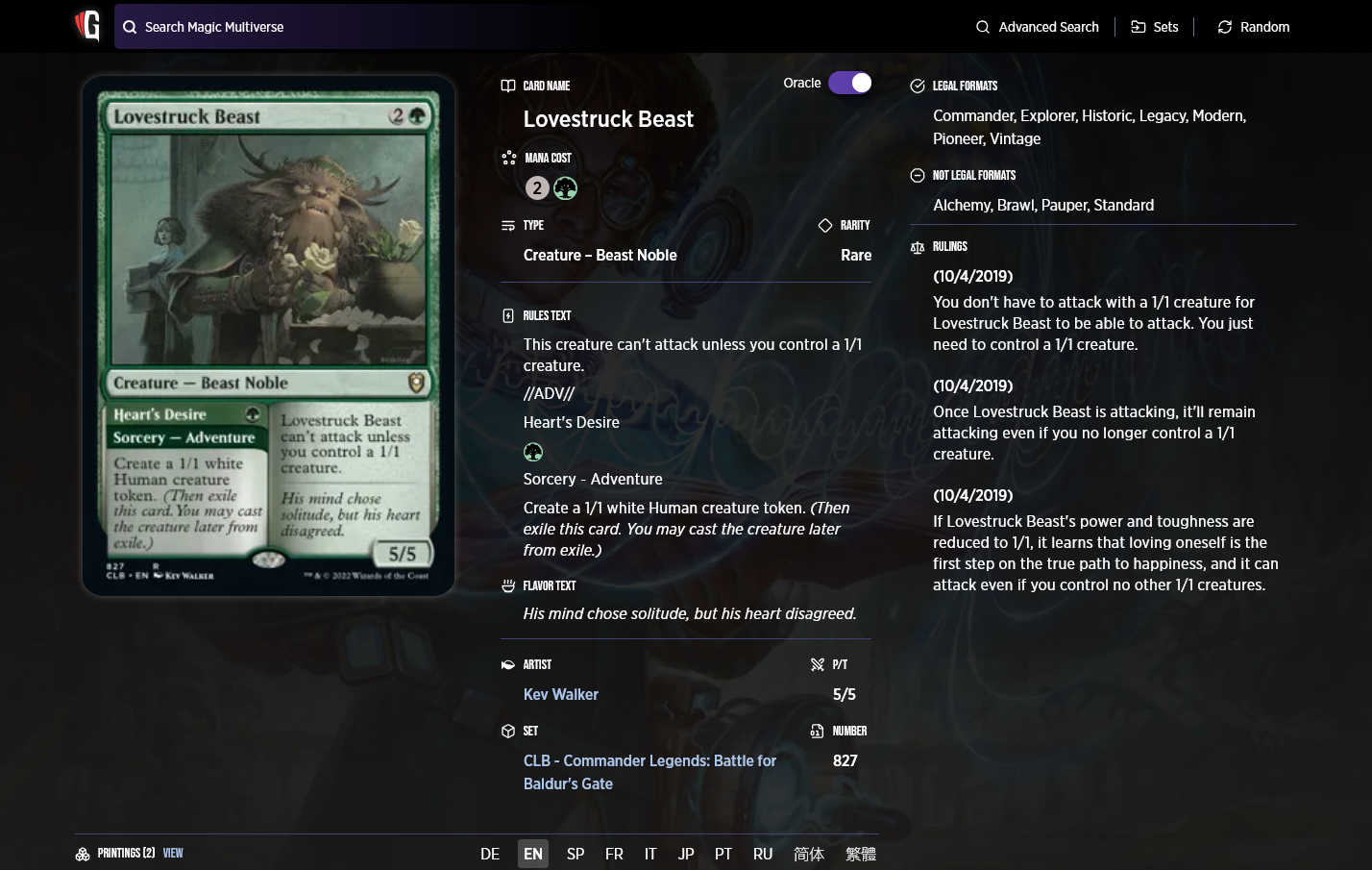
So, adventurer cards have two distinct pages on Gatherer 2.0: one page contains the Oracle text for the whole card, while the other page is just a placeholder for the Adventure component. When searching for the card by name, both entries appear on the result page, and in the default display, they are indistinguishable from one another; getting more information requires switching to a list view. The placeholder page has no link to the other page, where the Oracle text for the Adventure could actually be found, and said Oracle text is crammed into the rules text of the main component. How does this compare to Gatherer 1.x?
In Gatherer 1.x, multi-component cards also had multiple entries in search results. If I searched for all cards in the Throne of Eldraine set, the result page showed one entry for Lovestruck Beast and one entry for Heart’s Desire. However, the default display combined card images with an Oracle text preview, so the name of the component, along with the name of the card itself, was shown next to the card image.
Regardless of which link I clicked on in Gatherer 1.x, I always ended up at the same page, because while Lovestruck Beast and Heart’s Desire had different entries in the search result, they shared a page for their Oracle entry. That page was split into two columns and each column had the regular layout for an Oracle entry. The left one showed the Oracle text of Lovestruck Beast (and only Lovestruck Beast) and the right one showed the Oracle text of Heart’s Desire. This layout was used for all multi-component cards.
My opinion: Another clear improvement over Gatherer 1.x. When I searched for an adventurer card, I had to stop and read the name next to the card image to know what result I was looking at. Nobody has time for that! With Gatherer 2.0, I simply recall which name comes first alphabetically: the card’s name or the Adventure’s name. This is infinitely easier than reading two or three words.
Furthermore, the Adventure’s placeholder page reminds the user that an Adventure is not itself a card—it’s just an alternative set of characteristics belonging to the actual card. Stuffing the Adventure’s Oracle text into the rules text of the main component also helps with this; in Gatherer 1.x, countless users got confused over the two-column layout and thought that these were actually two distinct cards with the same card image.
Finally, the absence of a direct link between the two pages reminds the user to be attentive while searching for information on the internet; otherwise, they end up wasting time on pages with incomplete or even false information.
This ingenious design is how Gatherer 2.0 handles adventurer cards, flip cards, and omen cards. Split cards and double-faced cards are handled slightly differently.
Split cards and double-faced cards
When I search for “Fire Ice” on Gatherer 2.0, I get a “no cards found” page. When I correct my search term to “Fire // Ice,” I get a result with two entries, just like when searching for an adventurer card.
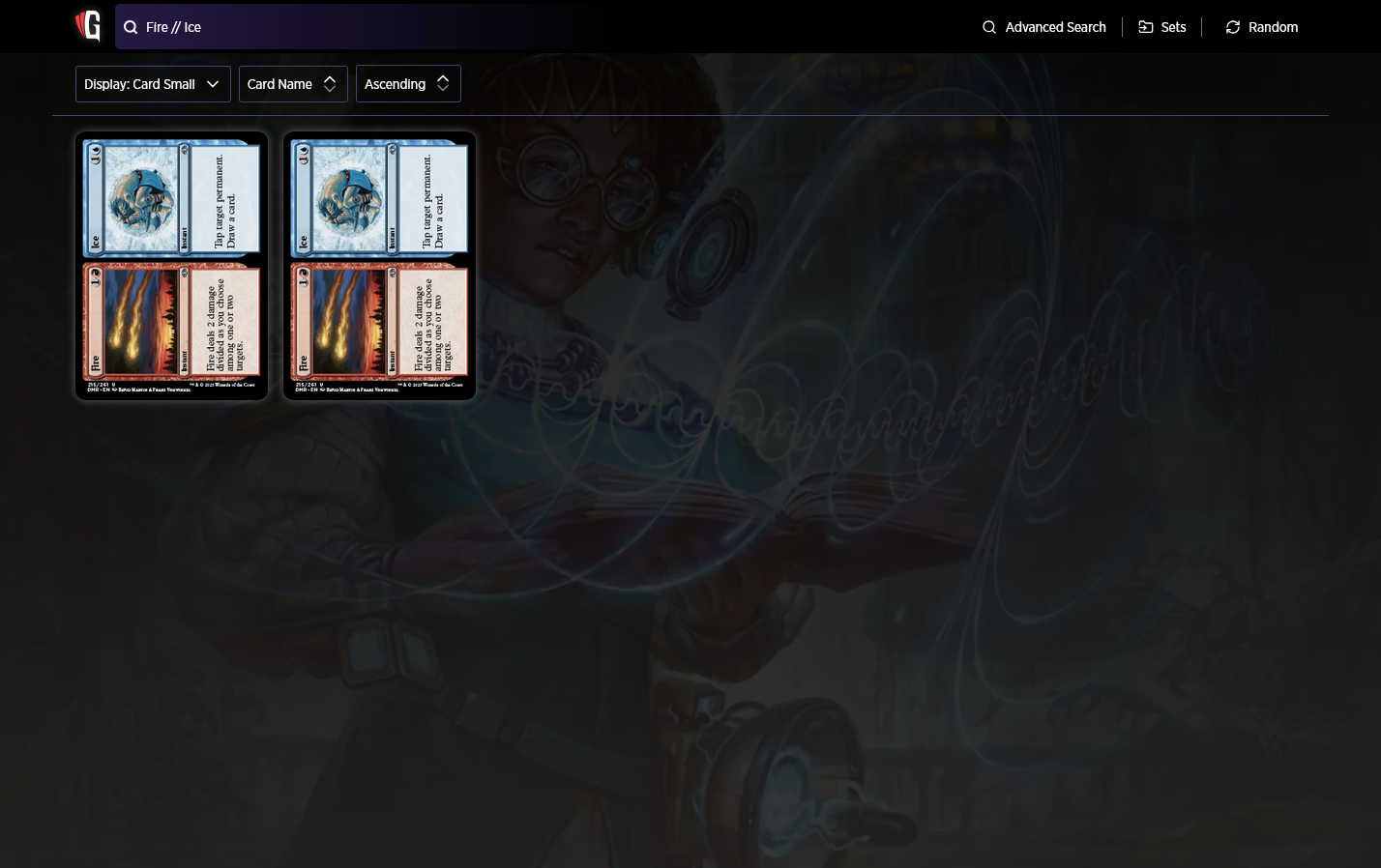
The differences appear when I click on one of the results. The first entry leads to a page for Fire, and the Oracle text on that page matches that of Fire. The second entry leads to a page for Ice, and the Oracle text on that page matches that of Ice.
What neither page contains is a link to the other page, nor even a hint of the other half’s Oracle text. The pages for double-faced cards are designed the same way.
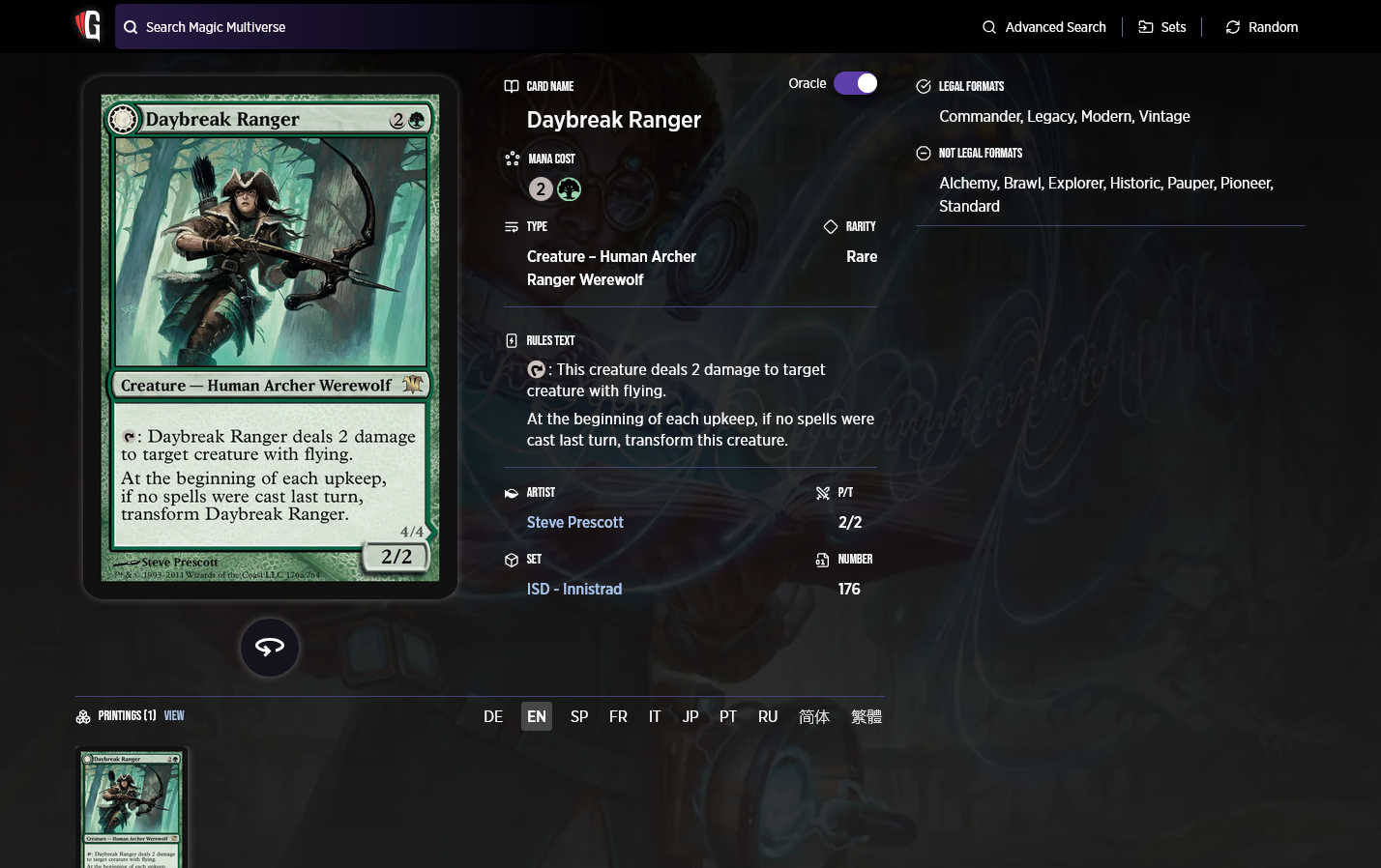
My opinion: Yet another clear improvement over Gatherer 1.x. Why would I ever want to look at the Oracle text of both halves of a split card at the same time? I can only cast one half of the card, after all, so the other half might as well be blank. Having the other half’s Oracle text on the same page, as in Gatherer 1.x., is unnecessary information that will just distract the user. The new design of Gatherer 2.0 finally solves this problem.
Similarly, only one face of a double-faced card can ever be up at any given time, so looking at both faces’ Oracle text at once is clearly unnecessary. Modal double-faced cards in particular behave much like split cards and don’t switch from one face to another once played, so it’s even less necessary for them.
Acceptance of acorn cards
For their final rebalancing, WotC removed the supertypes, types, subtypes, rules text, and loyalty values of a bunch of cards. Without a card type, those cards cannot be played like regular cards and are (almost?) impossible to get onto the battlefield. And even if they reach the battlefield, the loss of their rules text means that those cards won’t have much of an impact.
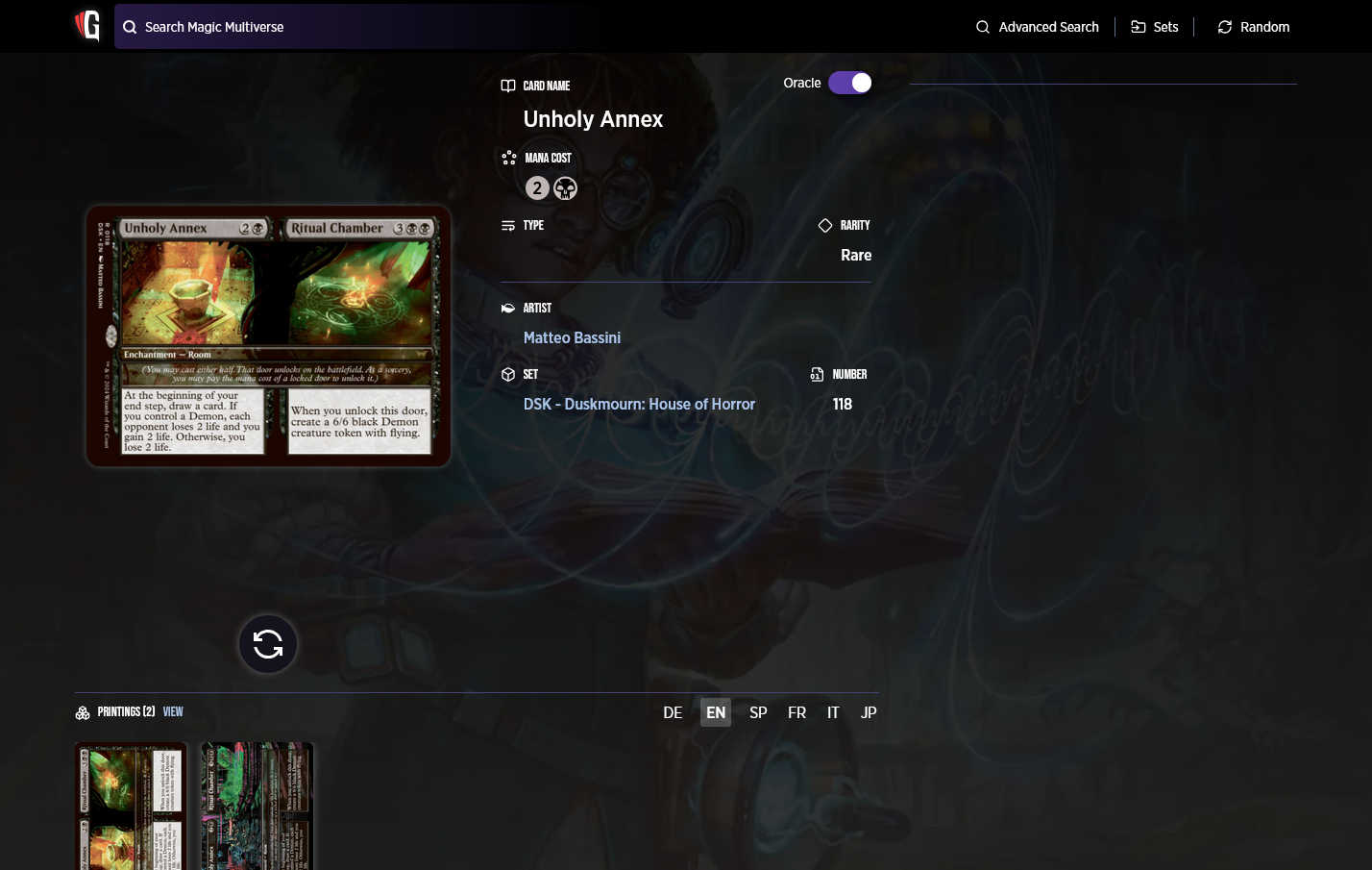
This rebalancing affects all the Rooms from Duskmourn: House of Horror and Duskmourn: House of Horror Commander, Human–Time Lord Meta-Crisis, Massacre Girl, Prime Killer, and specific versions of Balloon Stand, Foam Weapon Kiosk, Trash Bin, Sonic Screwdriver, and Brothers Yamazaki. Also affected are B.F.M. (Big Furry Monster, Right Side), Gleemax, Our Market Research Shows That Players Like Really Long Card Names So We Made this Card to Have the Absolute Longest Card Name Ever Elemental, Little Girl, Who // What // When // Where // Why, and Surgeon General Commander. Last but not least, this affects all playtest cards from Mystery Booster and Mystery Booster 2: Convention Edition.
An obvious effect of this rebalancing is the weakening of metagame-dominating Room decks. And just like the “reminder text to rules text” rebalancing, this also shows that WotC listen to player feedback: players dislike it when sets like Modern Horizons 2 introduce many powerful cards that turn the metagame upside down, forcing the players to buy these new cards to replace older, now obsolete cards. With rebalancing, WotC can make existing cards obsolete without printing new cards, making such artificial rotations less expensive for the player base.
The next obvious effect is the simplification of Mystery Booster events: without playable playtest cards, these events become much easier for judges to handle. I don’t think these were WotC’s primary objectives, however. To me, this specific rebalancing looks more like an effort to raise the acceptance of acorn cards in casual play.
Acorn cards often get branded as “not real Magic cards,” even in casual environments, and players wanting to use them in their decks need to negotiate house rules or “rule zero” them prior to each game. Now, these players can point to any of the rebalanced cards and say:
“What about the Unholy Annex that Steve played last game? That card has no rules text and it’s not even an enchantment anymore, but nobody objected when Steve played it. If we are all fine overruling the official Oracle text of that card, why are we still clinging to the tournament policy for Surgeon General Commander?”
This will not overcome all the prejudice arrayed against acorn cards, but it is a step in the right direction.
Version-specific rulings
Another thing WotC introduced with Gatherer 2.0 are version-specific rulings.
Previously, all Oracle entries for a given card always featured the same list of rulings, and this continues to be true for the vast majority of cards. The page for the Commander 2017 version of Path of Ancestry, for example, has the exact same rulings as the Modern Horizons 3 Commander version or any of the other twenty-eight versions. For some cards reprinted in the Magic: The Gathering—FINAL FANTASY release, however, WotC have introduced unique rulings or lists of rulings.
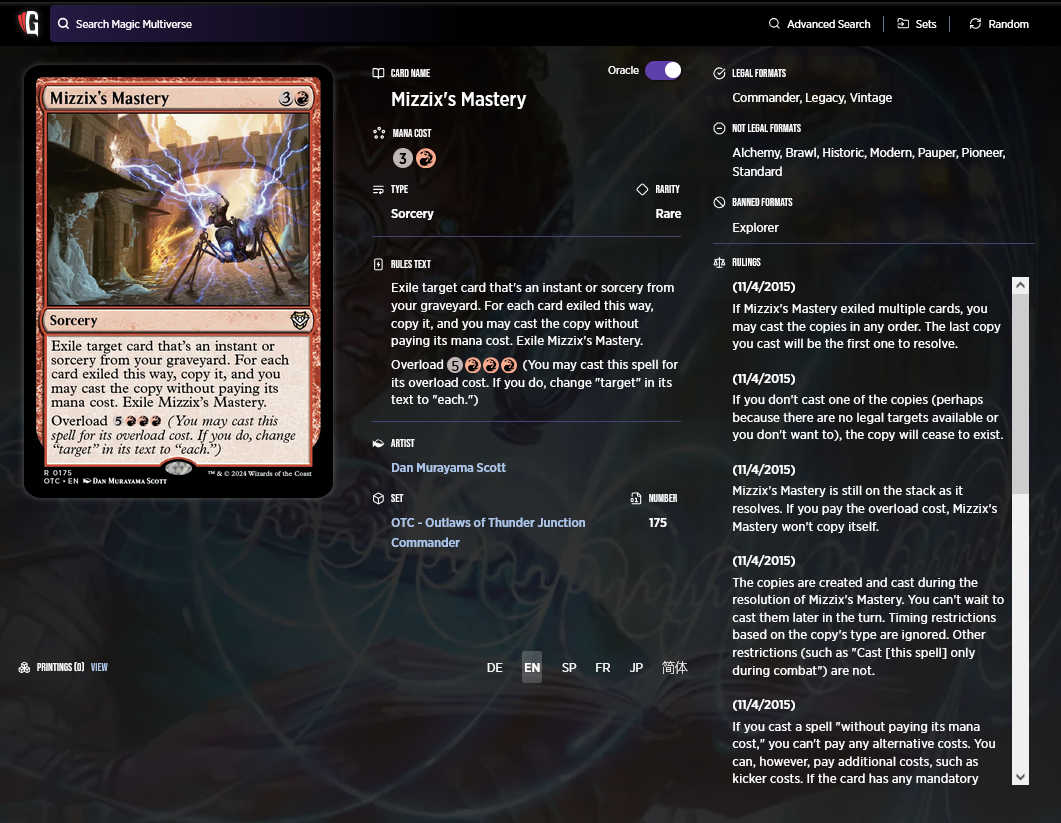
For example, older versions of Mizzix’s Mastery feature rulings explaining what happens with copies that are not cast and with their associated cards, and one ruling goes into more detail on which timing aspects are circumvented by the spell and which are not. The rulings for the new FINAL FANTASY Through the Ages version of Mizzix’s Mastery do not contain that information.
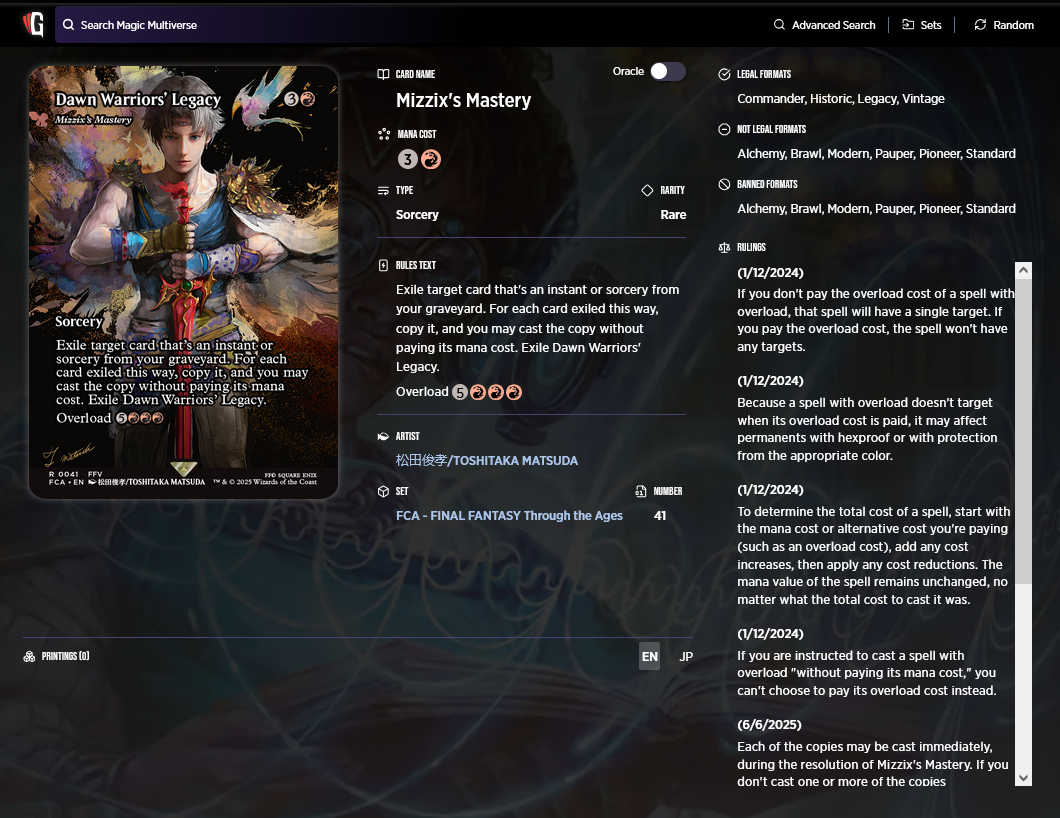
My opinion: This change greatly improves Gatherer’s functionality. It acknowledges the well-known fact that players with different versions of a card have different questions about the card. Those playing with a FINAL FANTASY Through the Ages version of Mizzix’s Mastery know that any copies not cast cease to exist, so that ruling is simply not needed for them; players using a Ravnica Remastered version, on the other hand, are usually not familiar with that concept and will benefit from such a ruling.
The initial selection of cards to receive this treatment is rather small (less than three dozen), but it shows the potential of this change. Currently, a user may have to scroll through a long list of rulings looking for one that matches their current scenario. But imagine a future Gatherer where each of the thirty versions of Path of Ancestry has its own carefully curated list of rulings; each list will be ordered in such a way that the rulings most relevant to that specific version appear at the top of the list. With that Gatherer, the user can simply navigate to their specific version of Path of Ancestry and find the desired ruling more quickly. And should the user not find a matching ruling in that list, they can safely conclude that the other versions won’t have one either, thanks to WotC’s expertise in data collection and analysis.
Searching for cards
After looking at the Oracle text that Gatherer 2.0 provides or doesn’t provide, and some of the supplemental information, such as rulings, the last thing I looked at were the search options.
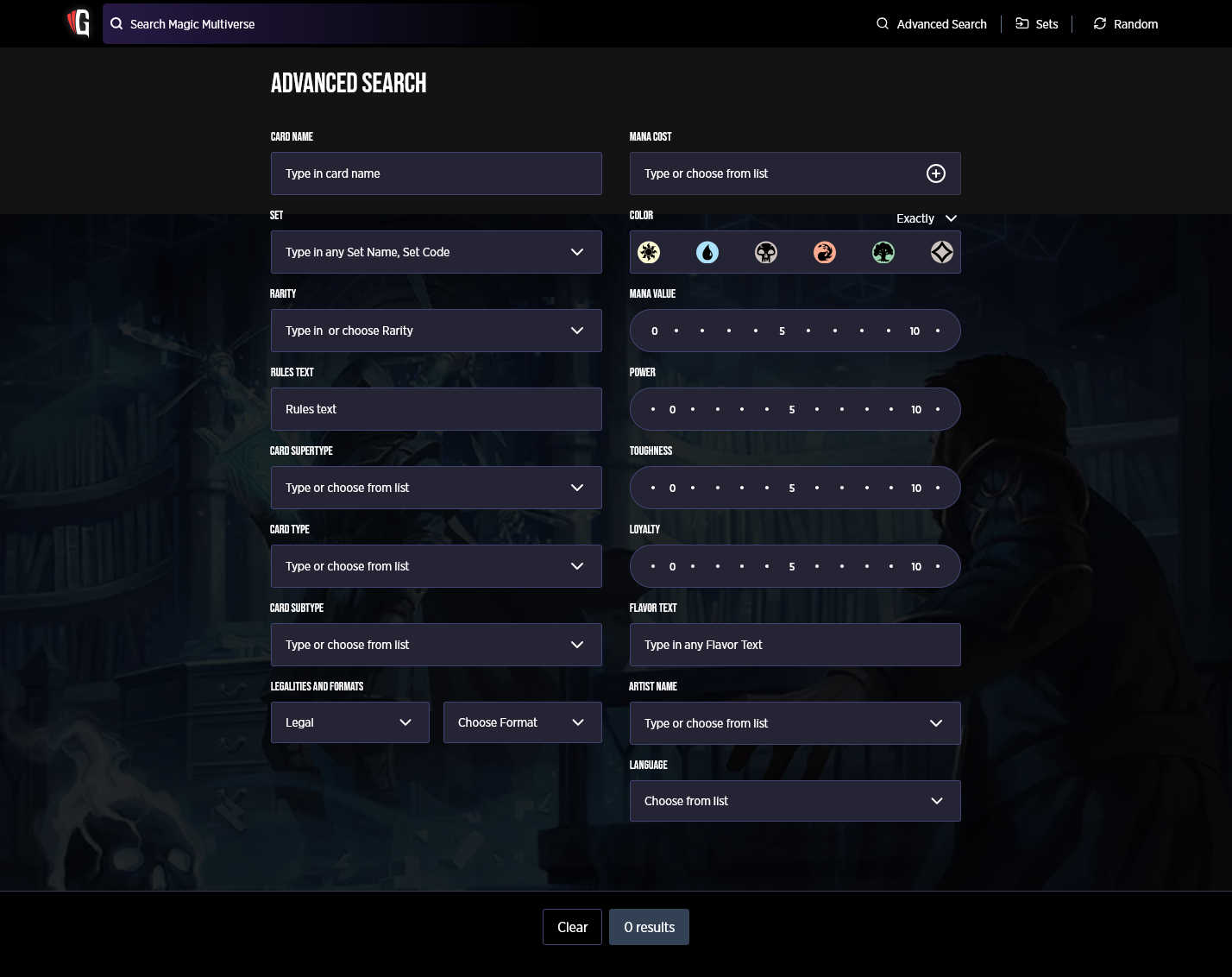
The fields offered by the search form are mostly the same as in Gatherer 1.x. Missing are fields for watermarks, hand and life modifiers, community ratings and comments, and for blocks. Given that Gatherer 2.0 has entirely done away with most of that information and that none of the cards on Gatherer have values for the remaining fields, losing these search options is no big loss.
On the other hand, Gatherer 2.0 adds new fields for loyalty and languages. There is no field for defense, but given that WotC removed all existing defense values, it makes sense to not let users search for them.
I don’t remember much about Gatherer 1.x’s search behavior, so most of the time, I cannot compare Gatherer 2.0’s behavior to its predecessor.
Names
When I search for “oblin,” I get 241 results: “Goblin,” “Goblins,” “Hobgoblin,” and so forth. Looks okay.
When I search for “Nicol Bolas,” I get seven results; when I search for “Bolas Nicol,” however, I get zero results. So Gatherer 2.0 searches for the exact same string of characters I entered in the name field.
Can I somehow split the two words, so that Gatherer 2.0 searches for card names that contain “Bolas” and “Nicol” in any order? The page gives me no such option, and while I might be able to manipulate the search URL to get the desired result, I think that Gatherer 2.0 should be judged on its own. Therefore, searching for names containing two specific phrases is not possible.
Gatherer 1.x allowed for such a search by combining two search criteria with AND, OR, and NOT. Building these search queries was rather cumbersome and prone to errors, but at least this feature existed if a user wanted to use it.
Gatherer 2.0 also shows an interesting behavior around longer name searches. If I search for “Nicol Bolas, the Deceiver,” I get three results: Nicol Bolas, the Deceiver, Nicol Bolas, the Ravager, and Nicol Bolas, the Arisen. Apparently, Gatherer 2.0 cuts off the string I entered after the fourteenth or fifteenth letter without informing me in any way. Similar results happen for “Omnath, Locus of All” and “Knight of the Hokey Pokey.”
And finally, if I search for “Heart’s Desire,” I get no results, because Gatherer 2.0 searches only the printed names of cards, and not their Oracle names, so the placeholder for Heart’s Desire is found under “Lovestruck Beast,” but not under “Heart’s Desire.”
Sets and rarities
The next two fields are sets and rarities. Entries selected in these fields can be negated, so searching for cards released in Aetherdrift and searching for cards not released in Aetherdrift are both possible. The two fields also allow combinations of multiple entries: sets are automatically connected with OR, while rarities can be connected with AND or OR. It’s not apparent to me why Gatherer 2.0 treats these fields differently. The order of operations for combinations of AND and OR is also unclear to me; using an AND somewhere in the rarities results in zero results, except when most of the rarities are negated. As a user, I certainly have no idea how to make this work.
Rules text
Rules text is the most interesting field for most users, so it stands to reason that this field offers the most options.
When I search for “Goblin” among cards released in Onslaught, I get sixteen results. Among these results are cards like Festering Goblin, whose rules text reads “When this creature dies, target creature gets -1/-1 until end of turn.” That sentence does not contain the word “Goblin,” so why does Gatherer 2.0 list this card in the results?
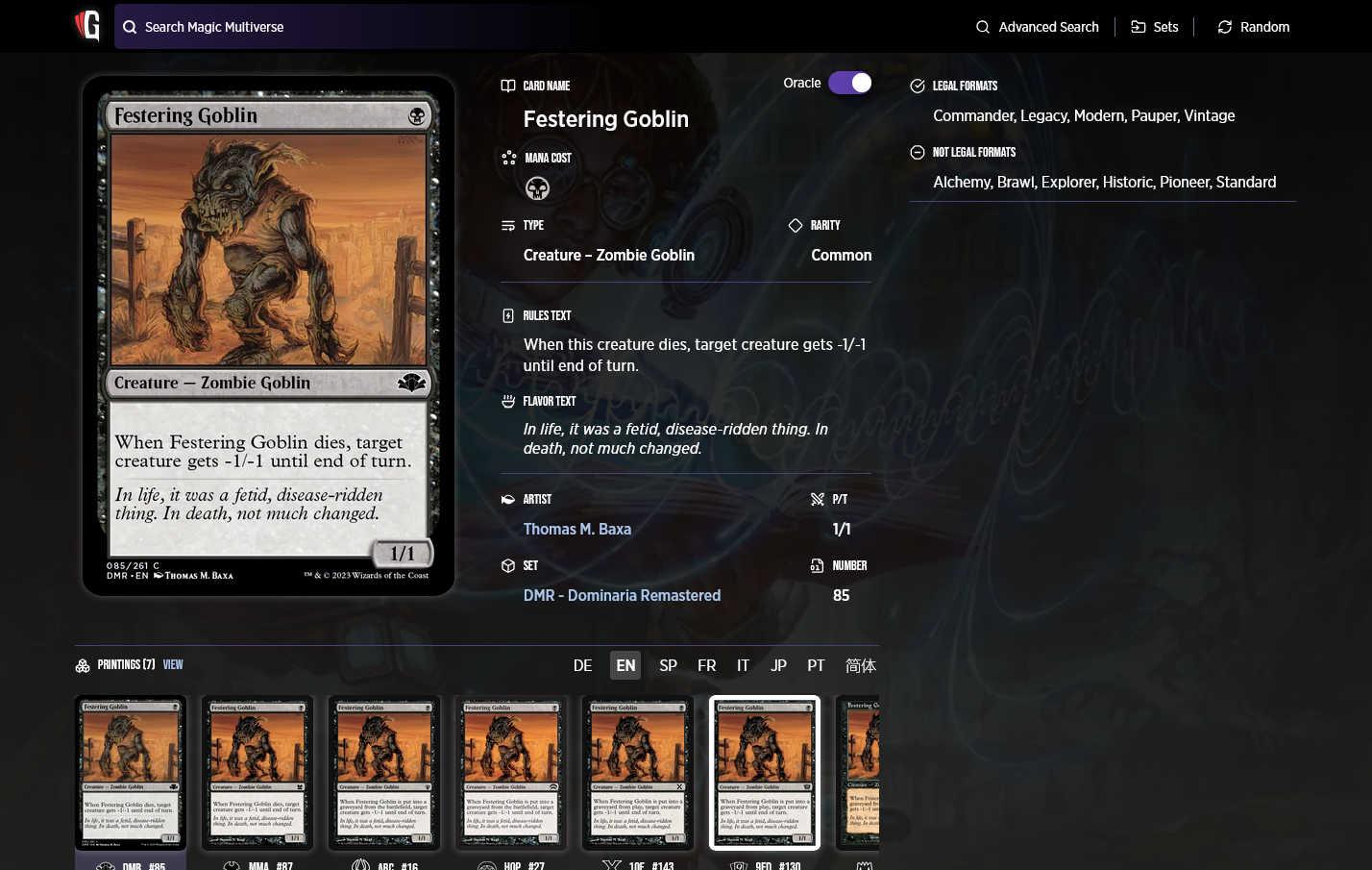
The answer is that Gatherer 2.0 searches not only the Oracle rules text, but also the printed rules text. In fact, when WotC released Gatherer 2.0, only the printed rules text was searched; an update in late June expanded the rules text search to look at both texts.
Searching through both rules texts is unfortunate. Searching just the printed text was at least understandable, since nobody is interested in Oracle text; again, “the go-to for players looking up card text, judges checking Oracle updates, and Vorthoses chasing down every mention of Squee” does not mention Oracle text anywhere. Currently, Gatherer 2.0 offers the worst option of all, without explaining any of this to the user.
So, when searching for cards which care about Goblins, I also get cards which don’t care about Goblins at all, so long as they have “Goblin” in their names, refer to themselves in their rules text, and were printed before November of 2024.
Did I say “cards which care about Goblins”? I should actually say “cards which care about ‘Goblin’,” because unlike with the name search, Gatherer 2.0 seems to add a word boundary to the start and end of the string I entered in the rules text field. In other words, my search for “Goblin” did not find any cards that refer to “Goblins” (unless they happen to refer to both).
So, when I want to find all cards that mechanically care about Goblins, I have to do two searches: one for “Goblin” and one for “Goblins.” I cannot do both at once and I have to sort out false positives like Festering Goblin myself.
Just as with the name field, I cannot search for two separate phrases. On the positive side, I can search for longer phrases such as “when this creature enters, create” and get the correct results.
The last thing I found is that Gatherer 2.0 largely ignores punctuation in the entered string: “goblin” and “goblin……” return the same result. Punctuation in the searched text also seems to get ignored: if I search for “creature when,” Gatherer 2.0 returns any card where one paragraph ends with “creature” and the next paragraph starts with “when.” The period and the newline between the words don’t seem to matter.
Card types, supertypes, and subtypes
All three fields allow for negated entries and combinations with AND and OR. Experimenting with these fields, I discovered that when I use OR to combine a positive entry with a negative entry, Gatherer 2.0 implicitly converts that OR into an AND. So “cards that are snow OR that are not legendary” becomes “card that are snow AND that are not legendary.” As a user, I am baffled by this behavior.
Another thing to note is that certain subtypes are not available, because WotC deleted them from all existing cards with their rebalancing initiatives, or because of the way Gatherer 2.0 organizes multi-component cards. For example, I cannot search for cards with the subtype Room or Adventure, because none of the entries in Gatherer 2.0 have these subtypes. For Rooms, that’s not so bad, because these cards don’t have rules text anyway, but if I wanted to build a Commander deck around Beluna Grandsquall, I would have to remember to search for the word “adventure” in rules text instead.
Format legalities
The legality field offers “legal,” “not legal,” “banned,” and “restricted,” but not “suspended.” I can enter multiple entries, but they are always combined with AND. So I can search for cards that are banned in both Modern and Legacy, but not for cards that are banned in Modern and/or Legacy. Similarly, I cannot search for cards that are banned or restricted in Vintage in one search.
Mana cost, color, and mana value
The mana cost field allows me to enter any string, but it also offers a list of the most common mana symbols. This list is invaluable, since the field does not use the notation defined by the Comprehensive Rules, and figuring out how to enter hybrid mana symbols and other “dual” symbols without these templates would be practically impossible.
When correctly entered, the search finds all cards (or components of multi-component cards) whose mana cost matches the entered string. It has to be an exact match; if I want to find all permanent cards with at least two white mana symbols for my devotion deck, I should better be prepared for a multitude of searches. Curiously, the field does not care about the order of the symbols: “W2” gets the same results as “2W.” As usual, punctuation is ignored, except as part of a properly entered “dual” symbol.
The color field allows me to select any number of colors, as well as colorless.3 All selected entries are combined with exactly one mode: “exactly” and “exclude” do what most people would expect them to do; only “include” may be a bit strange for returning all cards that have at least one of the selected colors (rather than returning cards that have all the selected colors, and maybe more).
One notable finding is that Gatherer 2.0 seems to ignore characteristic-defining abilities, so it treats cards with devoid as having the colors derived from their mana costs. An exception from that rule are cards such as Eldrazi Linebreaker, where the colorless mana symbol in the mana cost may cause Gatherer 2.0 to interpret the card as colorless.
For the mana value, I can search for any value from 0 to 10 or for all values of 11 or higher. Also, I can search for a range such as 1 to 3 or 8 to 11 or higher. Notable results are:
Split cards are only found via the mana values of their two halves, rather than their combined mana value, since Gatherer 2.0 treats the halves as completely unrelated from each other.
A search for mana value 0 does not return any lands, nor does it find any other cards without a mana cost. Apparently, Gatherer 2.0 treats cards without a mana cost as having no mana value. This also applies to the back faces of transforming double-faced cards and the combined back faces of meld pairs. No mana cost? No mana value.
Power, toughness, and loyalty
These fields offer the same options as the mana value field, with an additional value for –1 (displayed as “X” on the search page). The only interesting find is that Gatherer 2.0 interprets anything beyond a simple number as 0, even if that value can never be 0 by itself, such as the toughness of Tarmogoyf.
Flavor text and artists
Now for the second-most important thing: “chasing down every mention of Squee.”
If I search for “Squee,” I get thirty-seven results. Are these all the mentions of Squee in flavor text? Of course not. As with rules text, Gatherer 2.0 adds word boundaries, so if I want to find a mention like “Squee’s cooking,” I need to make a second search for “Squee’s.” Notably, just adding an apostrophe doesn’t suffice, as Gatherer seems to ignore trailing special characters.
Then again, it’s about “chasing down,” and if I could find all the mentions with just one search, it wouldn’t really count as a chase.
For the artist field, there isn’t much to say. It offers negations and combinations with AND and OR, and the behavior of AND/OR combinations is still a mystery to me.
Languages
The language field is a new search option. To the best of my knowledge, Gatherer 1.x automatically selected a language upon a user’s first visit (probably based on the browser’s language). Gatherer 1.x would then search only through cards of that language, so there was confusion whenever a user searched for a string not matching the language Gatherer 1.x had selected for them. A user could change the language manually, but this was not obvious.
Gatherer 2.0 improves upon this behavior by making searches in languages other than English an option the user has to explicitly select.
Searching in other languages is a mixed bag for me. The UI itself is only available in English, so some basic English vocabulary is still required, as well as some Magic vocabulary, since fields with predefined entries, such as subtypes or sets, are still in English.
This narrows down the relevant fields to the card name, the rules text, and the flavor text. Searching these fields works, although Gatherer 2.0 continues to search both the printed rules text and the Oracle rules text, and for non-English cards, only the printed text is in the other language. The Oracle rules text is always in English, so this may lead to some strange search results.
Last but not least, if I visit the Oracle entry for a non-English card, only the card name, the rules text, and the flavor text are in that language; the type line remains English.
Conclusion
I initially had mixed feelings about WotC’s announcement of Gatherer 2.0. Now that I had a chance to explore the new version, I can say that all my concerns were entirely unfounded. WotC have outdone themselves with their new website.
The go-to for players looking up card text, judges checking Oracle updates, and Vorthoses chasing down every mention of Squee.
I can absolutely look up any card text that exists on Gatherer. Gatherer 2.0 provides the highly requested feature of searching for printed rules text, and once WotC eliminate the distracting simultaneous search through Oracle rules text, searching on Gatherer 2.0 will be perfect.
Judges have always checked Gatherer for Oracle updates, because that’s the place where these updates are published. Gatherer’s new design makes it an even better place to check for updates though, because the redesign bricked the workflow of everyone else; even major players like Scryfall have not caught up yet with Gatherer 2.0 (based on missing Gatherer links for newer cards, as well as outdated Oracle text).
Finding every mention of Squee on Gatherer 2.0 is certainly a chase; it requires research into the search algorithm’s behavior and careful planning of search terms.
So, Gatherer remains the premier address for all these use cases. Full points for that.
This update is all about making Gatherer feel cleaner, more modern, and easier to use—whether you’re on desktop, a tablet, or your phone.
With Gatherer 2.0, WotC have removed large amounts of information from Gatherer, including gameplay-relevant information such as color indicators and defense values. Displaying less information makes Gatherer 2.0 feel cleaner; it’s modern in the sense of companies randomly erasing information from their websites, as well as WotC’s own goal of making fans unable to learn or even know about all existing cards; and it makes Gatherer 2.0 easier to use, as users don’t have to look for information that’s not there.
WotC have also split multi-component cards into entirely different Oracle entries. As a result, the Oracle text of such cards is scattered across two or three separate pages, with no link from one to another; in some cases, the Oracle text is instead on one of the pages, and the other pages are just distractions that contain no relevant data. This redesign gives all pages a uniform look, which makes Gatherer 2.0 feel cleaner; it’s modern in the sense of prioritizing a company’s time and money over product usability; and it makes Gatherer 2.0 easier to use by giving users a reason to not use Gatherer for such cards.
Next, WotC reduced the number of search options. Having less options makes for a cleaner interface; taking options away from users, especially experienced users, is a modern trend; and having less options makes searching on Gatherer 2.0 easier, since each impossible search is one less thing a user has to think about.
All in all, full points for a clean and modern look and feel, and for ease of use.
Apart from all that, Gatherer 2.0 also marks WotC’s first foray into large-scale rebalancing of tabletop Magic, which trumps everything seen on MTG Arena. WotC added rules text to thousands of cards, significantly changed the Oracle text of hundreds of cards, even to the point of making cards unplayable in 99.9% of all situations, and removed two cards entirely from Gatherer.
The impact of these changes will no doubt be enormous, and I look forward to all the great brews players will come up with. If the community reacts to these tabletop rebalancings as enthusiastic as I expect them to, WotC will surely redouble their efforts and make rebalancing a regular part of new releases. Something we can all look forward to.
It is also just the first step in a series of improvements we’ll be delivering throughout the year. But more on that later. For now, we hope you enjoy the refreshed look.
Looking at all the great features Gatherer 2.0 released with, I can hardly believe that there is still room for a whole series of improvements, but WotC wouldn’t be WotC if they didn’t find a way to innovate. I guess we have to wait and find out.
In the meantime, remember to share your enthusiasm about Gatherer 2.0 with WotC, and tell them to keep up the good work.