
(Originally published on 2025-09-05; last reviewed on 2025-09-05; last updated on 2025-09-05)
As part of the Magic: The Gathering—FINAL FANTASY release, Wizards of the Coast (WotC) gave the official Oracle card reference a much-needed overhaul: Gatherer 2.0.
To celebrate this momentous occasion, WotC came up with some truly spectacular ideas, many of which I documented in the first Brave New Gatherer article. Some highlights include
- Upgrading all reminder text to rules text.
- Removing the rules text of hundreds of cards.
- Removing two cards entirely.
- Removing all color indicators, defense values, hand modifiers, and life modifiers from all cards.
Two months later, the Edge of Eternities update brought further changes to Gatherer, so it seemed time for another article.
Reminder text is back
In my previous article, I applauded WotC for bringing card rebalancing from MTG Arena into the world of tabletop Magic.
Alas, it seems the rest of the community has shown complete disregard for WotC’s attempt at shaking up tournament formats without resorting to bannings or overpowered Horizons sets. I haven’t seen a single article about this update’s impact on the tournament scene, no video about the brokenness of this change, no nothing.
WotC must be disheartened by this total lack of reaction, but true to form, they listened to the community feedback (or lack thereof), and reversed this update with the Edge of Eternities release. Reminder text is back and the summer of double cascade, double mobilize, and double affinity has come to an end.
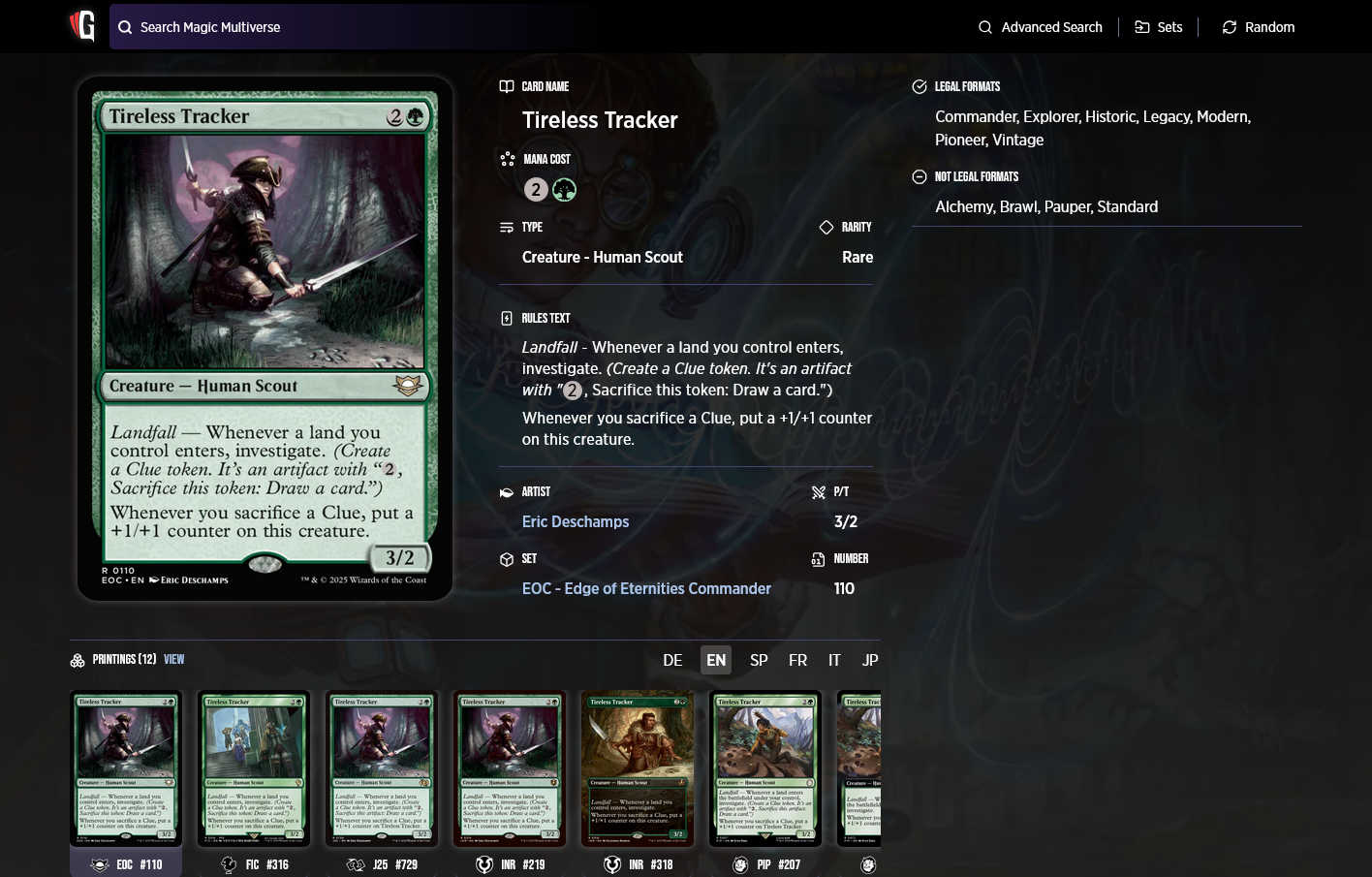
Well, mostly. For a sundry list of cards, WotC decided that a partial revert works better, and made only the first half or so into reminder text; the latter half still classifies as rules text. For an example, see Tireless Tracker:
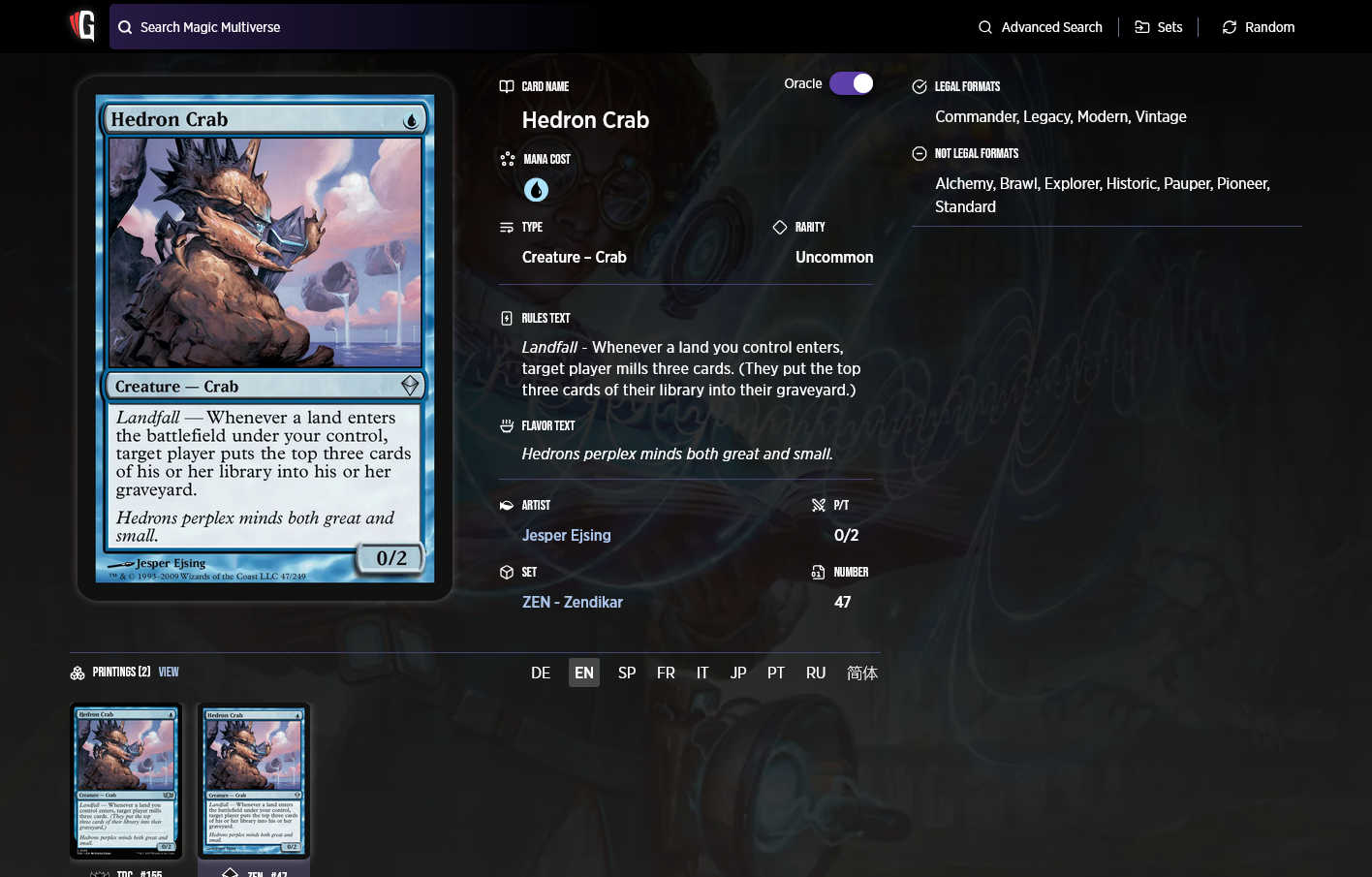
Next, there is one card whose fans must have shown some appreciation for the change from reminder text to rules text, because WotC exempted that card from the reversal. Thanks to its loyal fans, Hedron Crab continues to mill six cards per landfall trigger.
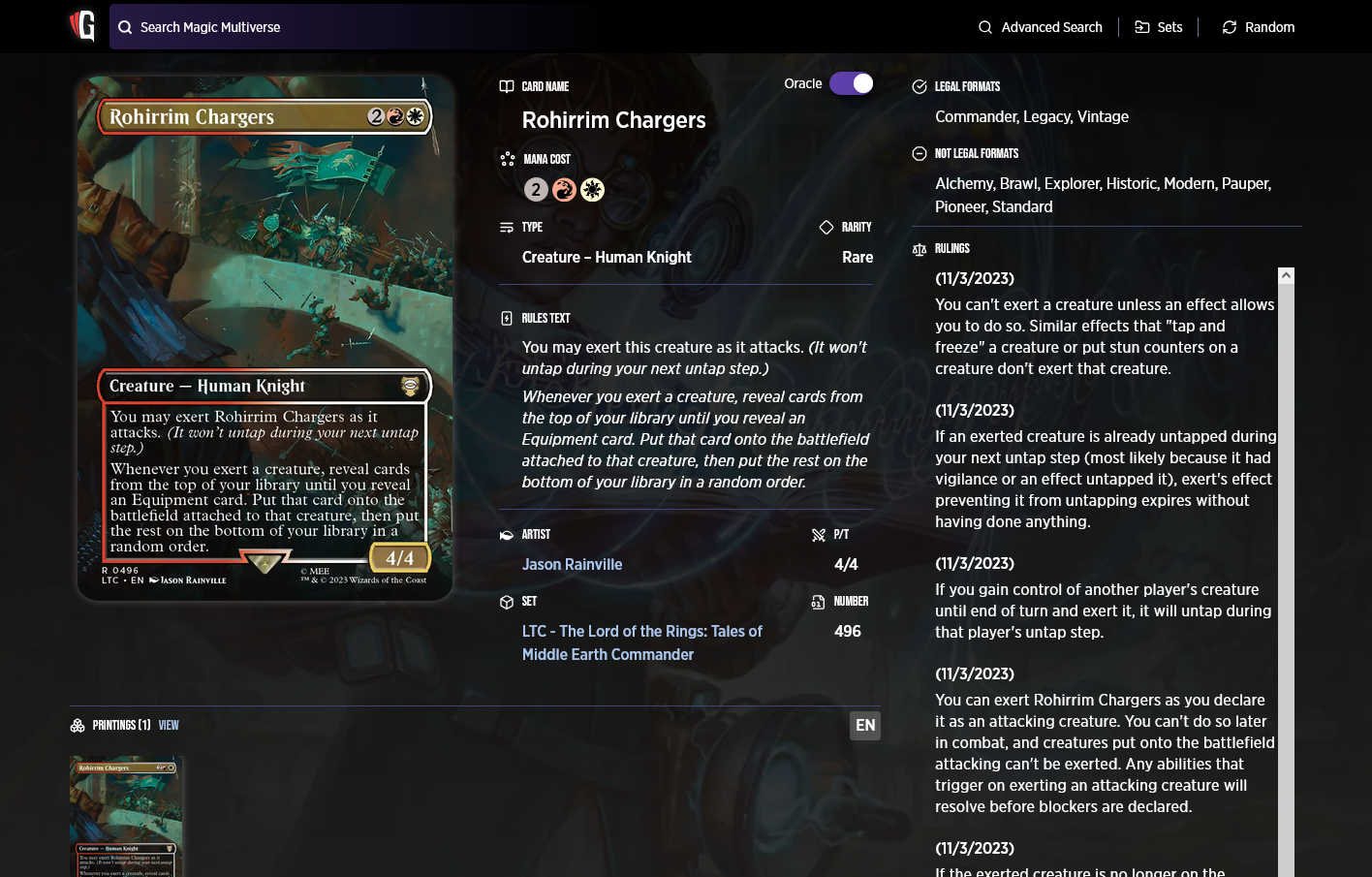
Finally, to maintain balance in the Multiverse, four cards had to give up other rules text in order to get back their reminder text. For example, Rohirrim Chargers had its reminder text restored at the cost of its triggered ability, which is now flavor text.
More rules text is gone
Rebalancing cards by deleting their rules text seems to have garnered a more positive reaction, because WotC have continued this “vanilla-fication” and stripped another hundred cards of their rules text.
First, all split cards are now vanilla, making them practically useless outside of increasing the storm count. The vast majority of the Magic community dislike split cards, because the cards’ flexibility and range of options make it harder for players to decide when and how to cast them, so this change seems a long overdue step toward better gameplay.

Second, all the Vec, Kor, and Dal people of Rath/Dominaria had to give up their rules text.
Also, Erase (Not the Urza’s Legacy One) sacrificed its rules text so that Gleemax and Who // What // When // Where // Why got theirs back. (They are still missing their card types, so it will do them little good.)
More card entries are gone
Going one step further and removing the entire Gatherer entry of a card also turned out to be a success, so WotC have doubled down and gotten rid of a remarkable seventy-six cards.
Generally, the removed entries can be classified into two groups: cards from Rabiah and Terisiare, and cards from Universes Beyond sets. The latter group makes me think that this could be a licensing issue; if so, legal reasons will probably prevent WotC from ever commenting on this issue.
For the complete list, see my unofficial Edge of Eternities update bulletin.
More actions for an amateurish look
Part of Gatherer 2.0 is a new system for displaying mana and other symbols. This system makes several mana symbols look quite different from how they appear on cards. Even better, the symbols can look different depending on whether they appear in a mana cost or in rules text. At the time, I speculated that WotC had deliberately chosen this nonprofessional look in order to encourage fans to share their own amateur creations with the community.
The Edge of Eternities update features another such attempt, this time with text instead of graphics. First, all dashes in rules text have been replaced with hyphen-minuses, as well as all dashes in the type lines of the new Edge of Eternities cards. Second, all bullet points have been replaced with asterisks.
Similar to the previous update, this one sends an encouraging message to aspiring writers and editors: if the publisher of the world’s premier trading card game does not see a need for proper punctuation on their website, why should you have to worry about your own?
No more version-specific rulings
Yet another great change in Gatherer 2.0 was the introduction of version-specific rulings. Even if two versions of a card have the exact same text, a player playing with one version will often have completely different questions about it than a player playing with the other version. Version-specific rulings would have been the way toward helping those players, by tailoring the rulings of each version toward its specific questions.
Alas, this initiative must have received negative responses, as WotC have stopped it completely. With the Edge of Eternities update, all the cards with different rulings across their versions had those rulings unified into a single list shared by all versions.
Rulings are mostly gone
WotC have not given up on unique rulings though. This time, instead of adding rulings to a single version of a card, they removed all occurrences of rulings except for a single one.
For example, cards with the job select keyword used to have a standardized set of four rulings which covered that keyword. Now, only one of those cards, Astrologian’s Planisphere, has those rulings on its Gatherer page.
This change affects ca. 7600 cards, and not everything fits cleanly. For example, the date seems to be part of a ruling’s text in this context, so a ruling can still appear across multiple cards if they received that ruling at different times. And some rulings still appear across multiple cards with the same date.
This change seems to be aimed at strengthening the judging community. If rulings become more difficult to find on Gatherer, players with rules questions are more likely to turn to judges for their answers. So thank you, WotC, for taking this step.
Conclusion
Apart from the reminder text thing, WotC continued with all their Gatherer 2.0 initiatives, so it seems they are on the right track. We will see if they can keep up that level of activity when Magic: The Gathering | Marvel’s Spider-Man releases later this month.