
(Originally published on 2025-08-19; last reviewed on 2025-08-19; last updated on 2025-08-19)
(Note: The release of Gatherer 2.0 severely delayed the writing of this article, and some of its information became outdated even during writing due to the Edge of Eternities update. Still, this update bulletin is for Magic: The Gathering—FINAL FANTASY, so I purposefully did not incorporate any of the new information. Edge of Eternities will get its own update bulletin.)
With each new set release, Wizards of the Coast (WotC) updates the Comprehensive Rules (CR) and the Oracle text of any number of cards. These updates include support for new mechanics, error fixes, and improvements to the wording of rules and cards. In the past, WotC regularly published update bulletins which summarized and explained these changes. They stopped this practice in the fall of 2023, and update bulletins now release only sporadically.
In my opinion, this is not a major loss, since there had already been a trend toward simplified bulletins that merely note the introduction of new rules, without commenting on their design, and because fixes for existing errors have become practically nonexistent. As such, a CR diff found on Academy Ruins contains just as much information as I would expect from an official update bulletin these days. The truly interesting parts were the ones that explained why a new rule or a rules change was written the way it was, as they help immensely in understanding the intent behind a rule.
Of course, one can still analyze these updates and draw their own conclusions, with or without an official update bulletin. As a rules enthusiast, I quite enjoy reading through these updates and trying to understand the reasons behind them and what corner cases the new rules cover or don’t cover. If you are also interested in Magic‘s game rules and you miss the old update bulletins, this article may be for you.
Disclaimer: I have no special insight into the inner workings of WotC’s rules team, so any observations are based solely on the published updates and my own knowledge of and experience with Magic’s rules system. While I strive for completeness and correctness, I may have missed some changes; in particular, my process for archiving and comparing Gatherer revisions is still a work in progress and it suffered serious setbacks from the introduction of Gatherer 2.0.1
Comprehensive Rules changes
For this section, I recommend having a CR diff open in another window, such as the one found on Academy Ruins.
Rules support for tripling
The Magic: The Gathering—FINAL FANTASY card Tifa’s Limit Break features the new keyword action triple. Specifically, the card triples a creature’s power and toughness.
Unsurprisingly, the rules for triple read virtually the same as the ones for the double keyword action: tripling a creature’s power and/or toughness creates a +X/+0, +0/+X, or +X/+Y effect based on the creature’s power and toughness at the time the effect is created. A negative power and/or toughness results in a negative X and/or Y.
WotC inserted triple’s rules entry at 701.11, after double’s, rather than alphabetically; subsequent keywords got renumbered accordingly. They also amended rule 107.1b, which defines situations where negative numbers are used or not used.
Rules support for job select
The Magic: The Gathering—FINAL FANTASY release introduces the new keyword ability job select.
Job select functions identically to its predecessors living weapon and for Mirrodin!, except for the specific characteristic values of the token.
The rules entry for job select is 702.182 and it reads the same as those of living weapon and for Mirrodin!, with the mentioned exception.
Rules support for tiered
The Magic: The Gathering—FINAL FANTASY release introduces the new keyword ability tiered.
Tiered works similarly to spree: the spell’s controller chooses a mode and pays that mode’s associated cost as an additional cost. The only difference is that spree allows choosing more than one mode, whereas tiered is restricted to exactly one mode.
The rules entry for tiered is 702.183 and is practically identical to spree. One noticeable exception is that the word “is” is missing from the first sentence of spree’s entry; in the new entry for tiered, that word is present. At a guess, the rules team wanted to put some extra love and care into creating Magic: The Gathering—FINAL FANTASY, and chose to make the rules for the new keywords grammatically correct. Outlaws of Thunder Junction, on the other hand, got to keep its error and received another one on top (see below); outlaws don’t care about rules, after all.
Additionally, WotC amended rules 700.2h and 702.172b. The first rule belongs to the section on modal spells and used to describe the special templating of modes on cards with spree. Since cards with tiered also feature costs before the modes’ text, but use traditional bullet points instead of plus signs, WotC dropped the mentioning of plus signs from this rule and moved it to the rules entry for spree, specifically rule 702.172b.
The amendment of rule 702.172b also includes what I think is a preview for an upcoming WotC initiative to improve the sustainability of modal cards: the cullet point. Made from recycled glass rather than ink, it will likely replace the traditional bullet point found on today’s modal cards. To compensate for the loss of bullet points, WotC added an extra period to the end of that rule.
Rules support for land cards with an Adventure
The Magic: The Gathering—FINAL FANTASY release introduces adventurer cards whose normal characteristics include the land card type.
WotC amended rules 715.3 and 715.3d to say “play” instead of “cast,” so that these new cards can be played as lands from exile after having been cast as Adventures.
Rules support for Zack Fair
The Magic: The Gathering—FINAL FANTASY card Zack Fair has an activated ability which puts Zack Fair’s counters on a creature (among other things). The activation cost includes sacrificing Zack Fair.
On its own, that instruction is impossible, since those counters don’t exist anymore when the ability resolves. However, the phrase “put [some object]’s counters” is short and easily understood by laypersons, so WotC used it for The Ozolith in the Ikoria: Lair of Behemoths release and introduced rule 122.8 alongside it. This rule covers the triggered abilities of The Ozolith and of other cards by redefining what putting counters means in this context.
Rule 122.8 only covers triggered abilities and Zack Fair’s ability is an activated ability, so WotC added rule 122.9 which makes the same redefinition for activated abilities. As a favor to rules enthusiasts, WotC elected to make the new rule apply only if the permanent is sacrificed, rather than future-proofing it with a broader definition as they did for rule 122.8. Consequently, rules enthusiasts can add “counter-moving ability where the permanent is exiled, bounced, or moved in some other way” to their preview-season watch list.
Rules support for Fang, Fearless l’Cie and Vanille, Cheerful l’Cie
The Magic: The Gathering—FINAL FANTASY release introduces a new meld pair composed of Fang, Fearless l’Cie and Vanille, Cheerful l’Cie.
WotC amended the list of meld pairs in rule 712.5.
Rules update for Zidane, Tantalus Thief (functional)
The Magic: The Gathering—FINAL FANTASY card Zidane, Tantalus Thief has a triggered ability with a unique trigger condition. This ability triggers whenever an opponent gains control of a permanent controlled by Zidane’s controller.
WotC amended rule 603.10d so that this ability “looks back in time” to determine whether it triggers from a control change. As a result, Zidane’s ability will trigger if an opponent gains control of Zidane itself, and it also triggers for each other permanent that changes controllers at that time.
Sagas without chapter abilities (functional)
The Saga creatures released in Magic: The Gathering—FINAL FANTASY prompted WotC to make changes to the rules governing Saga cards. Since creatures can lose their abilities significantly easier than noncreature permanents, Saga creatures will result in more situations where a Saga has no chapter abilities. To make these situations more intuitive, WotC made two changes.
The first change is that Sagas with no chapter abilities are exempted from the Saga-specific state-based action. Previously, that state-based action caused a Saga with no chapter abilities to be sacrificed almost immediately, since its largest chapter number is 0; now, such a Saga remains on the battlefield. For this change, WotC amended the state-based action’s definition in rules 704.5s and 714.4.
The second change is that Sagas with no chapter abilities are exempted from the Saga-specific turn-based action. Previously, that turn-based action caused a Saga with no chapter abilities to still get a lore counter each turn and effectively skip chapters until the ability-removing effect ended; now, such a Saga stays at its current chapter. For this change, WotC amended the turn-based action’s definition in rules 505.4, 703.4f, and 714.3b.
WotC did not change rule 714.3a which makes Sagas without read ahead enter the battlefield with a lore counter on them. Thus, a Saga with neither chapter abilities nor read ahead still enters with a lore counter, effectively skipping the first chapter.
903.1 (functional)
This is the introductory rule for the Commander variant.
WotC removed the reference to an independent rules committee and additional resources at MTGCommander.net. This eliminates confusion over a few contradictions between the rules posted on that website and the rules in the CR regarding color identity, deck construction, and bringing cards from outside the game into the game.
Rules added for Edgar, King of Figaro (nonfunctional)
The Magic: The Gathering—FINAL FANTASY card Edgar, King of Figaro has an ability which defines the results of specific coin flips.
WotC added rule 705.3 which elaborates on that ability’s effect. Notably, the effect of Edgar’s ability can cause a player to win a coin flip which otherwise would have neither a winner nor a loser.
Rules added for Saga creatures (nonfunctional)
The Magic: The Gathering—FINAL FANTASY release introduces cards which are both Saga enchantments and creatures.
The layout of these cards mostly matches that of a normal Saga card, except for a second text box below the type line and a power and toughness box in the customary lower right corner of the card. The second text box contains keyword abilities and flavor text.
WotC added rule 714.1a, which elaborates that the rules text found in the second text box is not associated with any of the chapter symbols of the first text box; abilities defined by that rules text are not chapter abilities and not tied to any chapter abilities.
Reordered keyword actions (nonfunctional)
WotC moved behold, goad, investigate, surveil, transform, and convert to the evergreen section of the keyword action list. Other keyword actions got renumbered accordingly.
206.5 (nonfunctional)
WotC updated the link to the Card Set Archive section of the Magic website.
700.7 (nonfunctional)
Some abilities refer to a specific object, and the way in which they refer to that object may include a description of it. Such abilities always refer to that object, even if the object does not currently match the description.
Rule 700.7 made this explicit for descriptions which use a characteristic value.
The recent templating update which replaced self-referential card names made such descriptions the norm, both those using characteristic values and those using other qualities. WotC amended rule 700.7, so that it also mentions “other qualities” as a catch-all for anything that is not a characteristic value.
702.176a (nonfunctional)
In the Tarkir: Dragonstorm update, WotC made two functional changes to the definition of the impending keyword ability, as well as a nonfunctional change to align the wording of the last three abilities.
In this update, WotC reverted the text of the second ability from “If this spell’s impending cost was paid, it enters with N time counters on it” back to “If you chose to pay this spell’s impending cost, it enters with N time counters on it.”
This is not a functional change, but it does serve to disrupt the uniformity of the abilities: previously, the last three abilities all used the wording “if this [object]’s impending cost was paid,” which is nearly universally used for such abilities; now, the second ability’s wording makes it stand out against the other two.
I guess WotC made this decision to remind the reader that, while abilities often appear uniform,2 each one is still unique and individual, with thoughts and feelings of its own.
721.9 (nonfunctional)
This rule is part of the controlling another player section.
WotC rewrote the first sentence to use a more formal wording.
Changes to card types, supertypes, and/or subtypes
New land type: Town.
New creature types: Hero, Moogle, and Qu.
Changes to glossary entries
New glossary entries: Job select, tiered, and triple.
Credits
WotC updated Charlie Cátinò’s name to Charlie Cactino.
Legal information
WotC added the following paragraph to the legal information at the end of the CR:
Moogle; Qu; Fang, Fearless l’Cie; Vanille, Cheerful l’Cie; and Ragnarok, Divine Deliverance ® & © SQUARE ENIX.
Oracle changes
Note 1: Most of the time, I will list only the changed parts of a card’s Oracle text, rather than the complete text of the card.
Note 2: Many of the Oracle changes documented below may seem difficult to believe; I myself would never have predicted them. Still, WotC made each and every one of these changes with the Magic: The Gathering—FINAL FANTASY update. (See my companion article for more information on the monumental achievement that is Gatherer 2.0.)
Now, at first glance, these changes may all look like errors made during the development of Gatherer 2.0. As a software developer myself, I can attest to the fallibility of programmers. But if you think even a little bit about it, this explanation cannot be true:
I easily found these things within two or three hours of durdling around on Gatherer. If a bloody amateur such as I was unable to not notice these issues, WotC’s quality assurance team must have noticed them as well. As the creators of the world’s premier trading card game, WotC take the quality of their products very seriously.3 Therefore, WotC must be aware of all these issues, and since they are present in the published version, all of them must be intentional.
Also, recent social media posts by WotC employees heavily suggest that WotC’s actions should always be regarded as intentional, be it a complex rules change, a clever creative decision, or a contentious templating choice. The first one also raises the excellent counterquestion of how WotC could have made these changes unintentionally. Judging tone on the internet is difficult, but the third post might even imply that, when encountering something that looks like an obvious error made by WotC, straight-up assuming it to be an error would be acting in bad faith.
So, to all judges reading this article, I recommend that you follow these changes to the letter when judging at official tournaments. If you overruled one of these changes, you would imply that you presume to know better than the talented and hardworking people at WotC. Instead, do as you always do during a judge call: analyze the board state and, when in doubt, check the official Oracle text at gatherer.wizards.com. That text is how WotC want their cards to work.
Reducing card name usage in rules text, part III (nonfunctional)
With the Magic: The Gathering Foundations release, WotC rolled out a new templating guideline for self-references in rules text. In short, most cases that previously used a card’s name now use “this [something].” In the updates for Magic: The Gathering Foundations, Jumpstart 2025, and Innistrad Remastered, WotC only updated cards from those releases. The Aetherdrift update applied the new guidelines to the remaining 13,000 cards.
Such a large update was bound to come with a few errors and inconsistencies, of which I identified somewhere between several dozen and well over a hundred, depending on how one counts. Meanwhile, a WotC employee posted on social media that WotC were aware of the errors and that the Tarkir: Dragonstorm update would bring corrections for these errors.
With that update, WotC did indeed fix nineteen errors/omissions. Since there were no announcements of future fixes, and the aforementioned post was quite definite on the number of errors, I had to conclude that the remaining issues were not errors.4 Accordingly, I relabeled them as “features” or “engagement triggers for rules enthusiasts.”
The Magic: The Gathering—FINAL FANTASY update brings guidelines for the new Saga creatures, new “features” on cards both new and reprinted—and two updates I would have called corrections in the past, but now are better named “feature reductions.” That last part was quite unexpected, and after some deliberation, I re-reclassified my remaining issues as “provisional features.” I look forward to the Edge of Eternities update and the next chapter in this saga.
Saga creatures
The Saga creatures released in Magic: The Gathering—FINAL FANTASY use both “this creature” and “this Saga.” Abilities whose effects are typically associated with creatures—dealing damage, fighting, gaining combat-related abilities—use “this creature.” All other abilities use “this Saga.”
Firion, Wild Rose Warrior
The ability given to the tokens should use “this token” instead of “this Equipment.”
Firion, Wild Rose Warrior
{2}{R}
Legendary Creature – Human Rebel Warrior
Equipped creatures you control have haste.
Whenever a nontoken Equipment you control enters, create a token that’s a copy of it, except it has “This Equipment’s equip abilities cost {2} less to activate.” Sacrifice that token at the beginning of the next upkeep.
3/3

Shinryu, Transcendent Rival
Prior to Magic: The Gathering—FINAL FANTASY, all legendary transforming double-faced cards with a “transforms into” ability used the complete card name. Sephiroth, One-Winged Angel also follows that guideline, but Shinryu does not.
Shinryu, Transcendent Rival
Legendary Creature – Dragon
Flying
As this creature transforms into Shinryu, choose an opponent.
Burning Chains — When the chosen player loses the game, you win the game.
8/8

For cards like Sephiroth, where both faces have the same character name, using the full card name is useful to avoid confusion. For Shinryu, that would not be necessary, but Olag, Ludevic’s Hubris sets a precedent for still using the full name. As such, Shinryu’s wording is inconsistent with Olag’s.
Olag, Ludevic’s Hubris
Legendary Creature – Zombie
As this creature transforms into Olag, Ludevic’s Hubris, it becomes a copy of a creature card exiled with it, except its name is Olag, Ludevic’s Hubris, it’s 4/4, and it’s a legendary blue and black Zombie in addition to its other colors and types. Put a number of +1/+1 counters on Olag equal to the number of creature cards exiled with it.
4/4

Red XIII, Proud Warrior and Garnet Til Alexandros 17th
The “shortened” names of both cards keep the regnal number. This is inconsistent with King Darien XLVIII, whose shortened name is just “King Darien.”
Red XIII, Proud Warrior
{1}{R}{G}
Legendary Creature – Beast Warrior
Vigilance, trample
Other modified creatures you control have vigilance and trample. (Equipment, Auras you control, and counters are modifications.)
Cosmo Memory — When Red XIII enters, return target Aura or Equipment card from your graveyard to your hand.
3/3

King Darien XLVIII
{1}{G}{W}
Legendary Creature – Human Soldier
Other creatures you control get +1/+1.
{3}{G}{W}: Put a +1/+1 counter on King Darien and create a 1/1 white Soldier creature token.
Sacrifice King Darien: Creature tokens you control gain hexproof and indestructible until end of turn.
2/3

Lethal Scheme
The Magic: The Gathering—FINAL FANTASY Commander version of Lethal Scheme does not follow the templating guidelines. If a spell refers to something that happened during the casting process, it should use “this spell.”
The reprinted version uses the card name instead. WotC also updated the Oracle text to this guideline-violating wording.
Old ability text:
Destroy target creature or planeswalker. Each creature that convoked this spell connives. (Draw a card, then discard a card. If you discarded a nonland card, put a +1/+1 counter on that creature.)
New ability text:
Destroy target creature or planeswalker. Each creature that convoked Lethal Scheme connives. (Draw a card, then discard a card. If you discarded a nonland card, put a +1/+1 counter on that creature.)
Bronze Guardian
The Magic: The Gathering—FINAL FANTASY Commander version of Bronze Guardian does not follow the templating guidelines. An ability that works in all game zones, such as a characteristic-defining ability, should use the card name.
The reprinted version uses “this creature” instead. This wording only appears on the printed card though; WotC did not update the Oracle text.
Bronze Guardian
{4}{W}
Artifact Creature – Golem
Double strike
Ward {2} (Whenever this creature becomes the target of a spell or ability an opponent controls, counter it unless that player pays {2}.)
Other artifacts you control have ward {2}.
Bronze Guardian’s power is equal to the number of artifacts you control.
*/5

Wolf’s Quarry
During the Aetherdrift update, the rules text of Wolf’s Quarry had not been updated to use “this token.”
WotC updated the Oracle text to a guideline-compliant wording.
Old ability text:
Create three 1/1 green Boar creature tokens with “When this creature dies, create a Food token.” (A Food token is an artifact with “{2}, {T}, Sacrifice this token: You gain 3 life.”)
New ability text:
Create three 1/1 green Boar creature tokens with “When this token dies, create a Food token.” (A Food token is an artifact with “{2}, {T}, Sacrifice this token: You gain 3 life.”)
Mu Yanling, Wind Rider
The printed rules text of Mu Yanling uses “this creature” instead of the shortened name.
WotC updated the Oracle text to a guideline-compliant wording.
Old ability text:
When this creature enters, create a 3/2 colorless Vehicle artifact token with crew 1.
New ability text:
When Mu Yanling enters, create a 3/2 colorless Vehicle artifact token with crew 1.
Aptitude for affinity, part II (nonfunctional)
With the Aetherdrift update, WotC replaced most abilities that are functionally identical to affinity with an actual affinity ability.
One of the cards which did not receive an update at that time is Claws Out. With the Magic: The Gathering—FINAL FANTASY update, WotC updated the Oracle text to use affinity for cats.
Old ability text:
This spell costs {1} less to cast for each Cat you control.
New ability text:
Affinity for Cats (This spell costs {1} less to cast for each Cat you control.)
Reminder text is now rules text (functional)
With the Magic: The Gathering—FINAL FANTASY update, WotC removed the reminder text of all cards in Gatherer and replaced it with identically worded rules text.
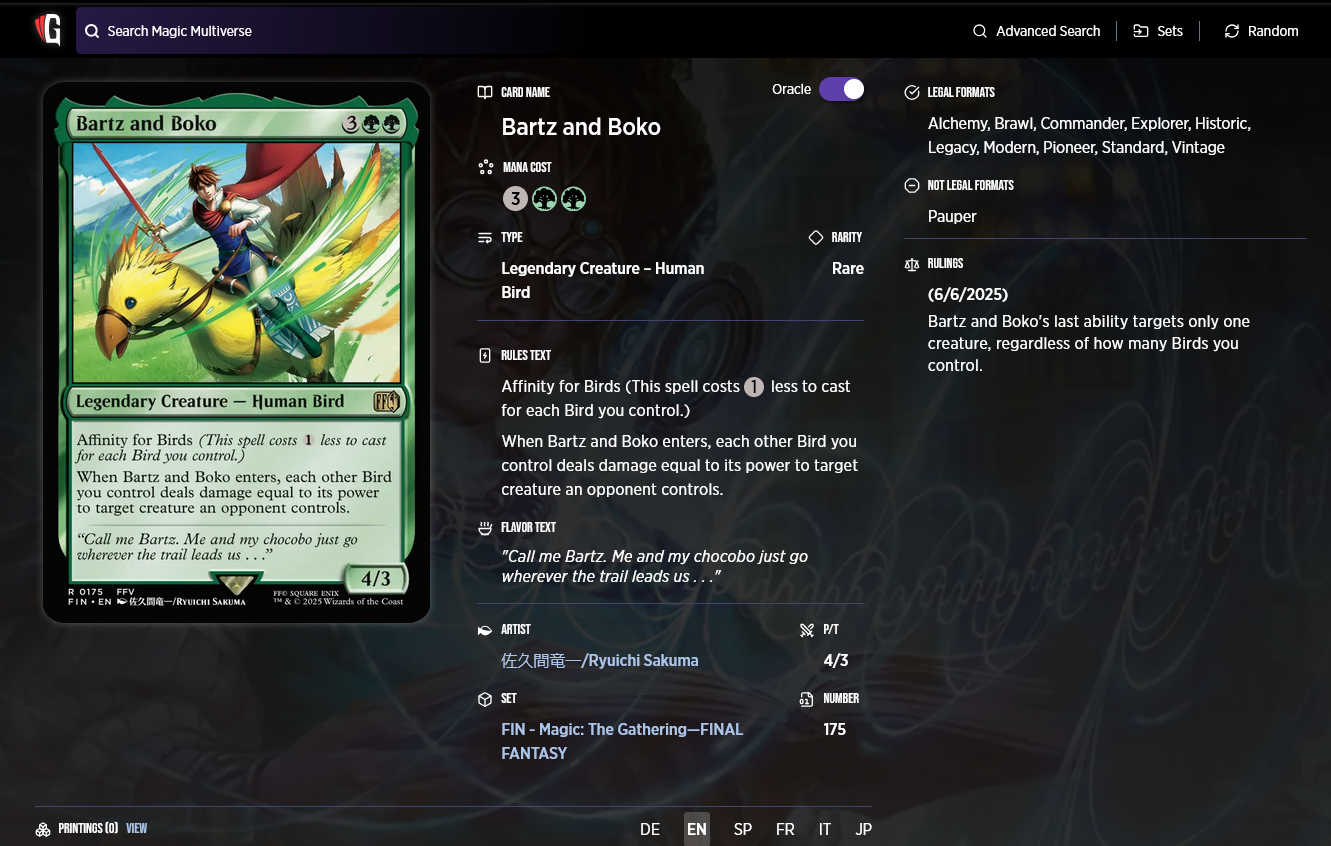
This update applies to more than 9,000 cards, including the cards newly printed in Magic: The Gathering—FINAL FANTASY. Due to the huge number of cards involved, I only did a rough analysis, the result of which is that about 5,000 cards were functionally changed.
The impact naturally varies from card to card. If the former reminder text described an activated ability, the card now has essentially two instances of that ability, which is seldom relevant. Former reminder text for a triggered ability, on the other hand, often results in two instances of that ability, which can be quite relevant. For static abilities, it depends on the specific ability. Former reminder text for keyword actions is often relevant, as it causes the action to be taken an additional time.
I leave it up to the interested reader to check how this update impacts the playability of their favorite cards.
Cards which lose their supertypes, types, subtypes, rules text, and loyalty (functional)
With the Magic: The Gathering—FINAL FANTASY update, WotC removed the supertypes, types, subtypes, rules text, and loyalty values of several hundred cards.
This update applies to: all sticker sheets from Unfinity, the lightless version of Balloon Stand, Foam Weapon Kiosk, the lightless version of Trash Bin, Human–Time Lord Meta-Crisis, Sonic Screwdriver (Classic), Massacre Girl, Prime Killer, all cards printed with the subtype Room, Brothers Yamazaki 1, and Brothers Yamazaki 2.
This update also applies to: B.F.M. (Big Furry Monster, Right Side), Gleemax, Our Market Research Shows That Players Like Really Long Card Names So We Made this Card to Have the Absolute Longest Card Name Ever Elemental, Little Girl, Who // What // When // Where // Why, and Surgeon General Commander.
This update also applies to: all playtest cards from Mystery Booster and Mystery Booster 2: Convention Edition, all cards first released in Jumpstart: Historic Horizons, all cards released in Innistrad: Midnight Hunt Alchemy, Kamigawa: Neon Dynasty Alchemy, and Streets of New Capenna Alchemy, all cards first released in Alchemy Horizons: Baldur’s Gate, and all Alchemy cards from Mystery Booster 2: Convention Edition.
Old Oracle text (example):
Bottomless Pool
{U}
When you unlock this door, return up to one target creature to its owner’s hand.
Locker Room
{4}{U}
Whenever one or more creatures you control deal combat damage to a player, draw a card.
Enchantment — Room
(You may cast either half. That door unlocks on the battlefield. As a sorcery, you may pay the mana cost of a locked door to unlock it.)

New Oracle text (example):
Color indicators are gone (functional)
With the Magic: The Gathering—FINAL FANTASY update, WotC removed the color indicators of all cards in Gatherer.
This update applies to several hundred cards, including cards newly printed in Magic: The Gathering—FINAL FANTASY. Notably, this affects the back faces of transforming double-faced cards, and suspend cards without a mana cost.
Old Oracle text (example):
Ancestral Vision
Color Indicator: Blue
Sorcery
Suspend 4—{U} (Rather than cast this card from your hand, pay {U} and exile it with four time counters on it. At the beginning of your upkeep, remove a time counter. When the last is removed, you may cast it without paying its mana cost.)
Target player draws three cards.

New Oracle text (example):
Ancestral Vision
Sorcery
Suspend 4—{U} (Rather than cast this card from your hand, pay {U} and exile it with four time counters on it. At the beginning of your upkeep, remove a time counter. When the last is removed, you may cast it without paying its mana cost.)
Target player draws three cards.
Defense is gone (functional)
With the Magic: The Gathering—FINAL FANTASY update, WotC removed the defense values of all cards in Gatherer.
This update applies to all thirty-six cards with the battle card type.
Old Oracle text (example):
Invasion of Belenon
{2}{W}
Battle – Siege
(As a Siege enters, choose an opponent to protect it. You and others can attack it. When it’s defeated, exile it, then cast it transformed.)
When this Siege enters, create a 2/2 white and blue Knight creature token with vigilance.
5

New Oracle text (example):
Invasion of Belenon
{2}{W}
Battle – Siege
(As a Siege enters, choose an opponent to protect it. You and others can attack it. When it’s defeated, exile it, then cast it transformed.)
When this Siege enters, create a 2/2 white and blue Knight creature token with vigilance.
Hand modifiers and life modifiers are gone (functional)
With the Magic: The Gathering—FINAL FANTASY update, WotC removed the hand modifiers and the life modifiers of all vanguard cards in Gatherer.
This update applies to all one hundred and seven cards with the vanguard card type.
Old Oracle text (example):
Barrin
Vanguard
Sacrifice a permanent: Return target creature to its owner’s hand.
+0 / +6

New Oracle text (example):
Barrin
Vanguard
Sacrifice a permanent: Return target creature to its owner’s hand.
Cards which have been removed entirely (functional)
With the Magic: The Gathering—FINAL FANTASY update, WotC removed two cards from Gatherer entirely. As a result, these cards no longer have Oracle text.
This update applies to: Sewers of Estark and Windseeker Centaur.
Old Oracle text (example):
Sewers of Estark
{2}{B}{B}
Instant
Choose target creature. If it’s attacking, it can’t be blocked this turn. If it’s blocking, prevent all combat damage that would be dealt this combat by it and each creature it’s blocking.
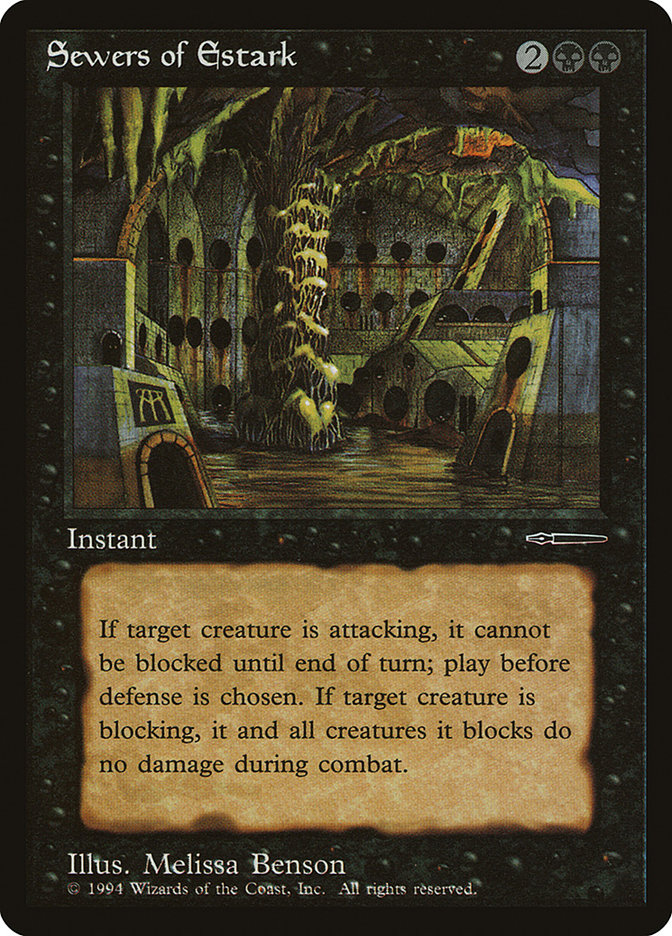
New Oracle text:
Restored loyalty (functional)
WotC added loyalty values to double-faced cards with one or more planeswalker faces; the loyalty values match the cards’ printed values.
This update applies to: Garruk Relentless, Gideon, Battle-Forged, Jace, Telepath Unbound, Liliana, Defiant Necromancer, Chandra, Roaring Flame, Nissa, Sage Animist, Arlinn Kord, Nicol Bolas, the Arisen, Tibalt, Cosmic Impostor, Lukka, Wayward Bonder, Rowan, Scholar of Sparks //// Will, Scholar of Frost, Arlinn, the Pack’s Hope //// Arlinn, the Moon’s Fury, Urza, Planeswalker, Teferi Akosa of Zhalfir, Ajani, Nacatl Avenger, Tamiyo, Seasoned Scholar, Sorin, Ravenous Neonate, Ral, Leyline Prodigy, and Grist, the Plague Swarm.
Old Oracle text (example):
Ajani, Nacatl Avenger
Color Indicator: White, Red
Legendary Planeswalker – Ajani
+2: Put a +1/+1 counter on each Cat you control.
0: Create a 2/1 white Cat Warrior creature token. When you do, if you control a red permanent other than Ajani, he deals damage equal to the number of creatures you control to any target.
-4: Each opponent chooses an artifact, a creature, an enchantment, and a planeswalker from among the nonland permanents they control, then sacrifices the rest.

New Oracle text (example):
Ajani, Nacatl Avenger
Legendary Planeswalker – Ajani
+2: Put a +1/+1 counter on each Cat you control.
0: Create a 2/1 white Cat Warrior creature token. When you do, if you control a red permanent other than Ajani, he deals damage equal to the number of creatures you control to any target.
-4: Each opponent chooses an artifact, a creature, an enchantment, and a planeswalker from among the nonland permanents they control, then sacrifices the rest.
3
Square brackets for cards with cleave (functional)
WotC added square brackets to the rules text of cards with the cleave ability, giving them their intended functionality for the first time.
This update applies to: Fierce Retribution, Lantern Flare, Alchemist’s Retrieval, Inspired Idea, Lunar Rejection, Wash Away, Winged Portent, Dread Fugue, Parasitic Grasp, Path of Peril, Alchemist’s Gambit, and Dig Up.
Old ability text (example):
Destroy target attacking creature.
New ability text (example):
Destroy target [attacking] creature.
Cheaper costs (functional)
With the Magic: The Gathering—FINAL FANTASY update, WotC lowered the activation costs of several activated abilities by effectively {9}, {18}, or even {99}. For two triggered abilities, a cost paid during the ability’s resolution was lowered by effectively {9}.
This update applies to: Draco, Mox Lotus, Spawnsire of Ulamog, Colossus of Akros, Phyrexian Triniform, The Tarrasque, Belt of Giant Strength, Realmbreaker, the Invasion Tree, Grim Giganotosaurus, and Redshift, Rocketeer Chief.
Old ability text (example):
{10}, {T}, Sacrifice Realmbreaker: Search your library for any number of Praetor cards, put them onto the battlefield, then shuffle.
New ability text (example):
{1}{0}, {T}, Sacrifice Realmbreaker: Search your library for any number of Praetor cards, put them onto the battlefield, then shuffle.
Jade Statue (functional)
WotC removed the power and toughness of the Limited Edition Alpha, Limited Edition Beta, and Unlimited Edition versions of Jade Statue. These versions now have the same Oracle text as the Ninth Edition version.
Old Oracle text:
Jade Statue
{4}
Artifact
{2}: This artifact becomes a 3/6 Golem artifact creature until end of combat. Activate only during combat.
3/6

New Oracle text:
Jade Statue
{4}
Artifact
{2}: This artifact becomes a 3/6 Golem artifact creature until end of combat. Activate only during combat.
Rage Extractor (functional)
WotC added the Phyrexian symbol {H} to Rage Extractor’s rules text, restoring the card’s original functionality.
Old ability text:
Whenever you cast a spell with in its mana cost, this artifact deals damage equal to that spell’s mana value to any target.
New ability text:
Whenever you cast a spell with {H} in its mana cost, this artifact deals damage equal to that spell’s mana value to any target.
Nissa, Steward of Elements (functional)
With the Magic: The Gathering—FINAL FANTASY update, WotC changed the loyalty of Nissa from X to 0.
Old Oracle text:
Nissa, Steward of Elements
{X}{G}{U}
Legendary Planeswalker — Nissa
+2: Scry 2.
0: Look at the top card of your library. If it’s a land card or a creature card with mana value less than or equal to the number of loyalty counters on Nissa, you may put that card onto the battlefield.
−6: Untap up to two target lands you control. They become 5/5 Elemental creatures with flying and haste until end of turn. They’re still lands.
X

New Oracle text:
Nissa, Steward of Elements
{X}{G}{U}
Legendary Planeswalker — Nissa
+2: Scry 2.
0: Look at the top card of your library. If it’s a land card or a creature card with mana value less than or equal to the number of loyalty counters on Nissa, you may put that card onto the battlefield.
−6: Untap up to two target lands you control. They become 5/5 Elemental creatures with flying and haste until end of turn. They’re still lands.
0
Curse of the Fire Penguin (functional)
WotC removed this card’s type, subtype, and rules text.
Old Oracle text:
Curse of the Fire Penguin Creature
{4}{R}{R}
Creature — Penguin
Trample
When this creature dies, return Curse of the Fire Penguin to the battlefield.
6/5

New Oracle text:
WotC also added an alternative Oracle text for this card, which features the card’s printed name and updated versions of its printed type line and rules text.
Alternative Oracle text:
Curse of the Fire Penguin
{4}{R}{R}
Enchantment – Aura
Enchant creature
This Aura consumes and confuses enchanted creature.
—–
Creature — Penguin
Trample
When this creature dies, return Curse of the Fire Penguin to the battlefield.
6/5

Acornelia, Fashionable Filcher (functional)
WotC added an acorn symbol {A} to Acornelia’s rules text, giving the card its intended functionality for the first time.
Old rules text:
Whenever you cast a spell with a squirrel in its art, you get (an acorn counter).
Whenever a Squirrel you control enters or dies, you get .
{2}{B}, Pay X : Target creature gets -X/-X until end of turn.
{G}, Pay X : Target creature gets +X/+X until end of turn.
New rules text:
Whenever you cast a spell with a squirrel in its art, you get {A} (an acorn counter).
Whenever a Squirrel you control enters or dies, you get {A}.
{2}{B}, Pay X {A}: Target creature gets -X/-X until end of turn.
{G}, Pay X {A}: Target creature gets +X/+X until end of turn.
Omniclown Colossus (functional)
WotC added the alternative characteristics to Omniclown Colossus’s rules text, giving the card its intended functionality for the first time.
Old rules text:
Affinity for Clowns (This spell costs {1} less to cast for each Clown you control.)
Trample
New rules text:
Affinity for Clowns (This spell costs {1} less to cast for each Clown you control.)
Trample
//ADV//
Pie-roclasm
{3}{R}{R}
Sorcery — Adventure
Pie-roclasm deals π damage to each non-Clown creature. (How to calculate π isn’t important. It’s a smidgen more than 3.)
Mana values are gone (nonfunctional)
With the Magic: The Gathering—FINAL FANTASY update, WotC removed mana values from Gatherer.
As stated in previous update bulletins, I think this is an overall positive change: the mana value of a card is not part of its Oracle text, so displaying it on Gatherer never had an effect on gameplay; computing the mana value of a card is trivial, so not much value was gained from having it displayed; but there were systematic errors with the mana values shown for the back faces of modal double-faced cards. Not displaying mana values anymore eliminates these errors at next to no cost, so I am all in favor of this update.
Exclamation marks in rules and reminder text (nonfunctional)
WotC added missing exclamation marks to rules text and flavor words.
This update applies to: Knight of the Hokey Pokey, Infernal Spawn of Evil, Kaboom!, Cardpecker, Save Life, Number Crunch, Spell Counter, Infernal Spawn of Infernal Spawn of Evil, Kill! Destroy!, Stop That, Deal Damage, Punctuate, Red-Hot Hottie, Touch and Go, Creature Guy, Laughing Hyena, Name Dropping, Ach! Hans, Run!, Water Gun Balloon Game, Clock of DOOOOOOOOOOOOM!, Treasure Chest, Undercity, Blood for the Blood God!, Company Commander, Kill! Maim! Burn!, Starlight Spectacular, Impounding Lot-Bot, Surprise Party, all versions of all cards with a “claim the prize!” instruction, all cards with the for Mirrodin! ability, Fear, Fire, Foes!, The Tenth Doctor, Dalek Drone, The Eleventh Doctor, Strax, Sontaran Nurse, Butch DeLoria, Tunnel Snake, and all cards with the start your engines! ability.
Old ability text (example):
Choose any number of target players or planeswalkers. For each of them, reveal cards from the top of your library until you reveal a nonland card, Kaboom deals damage equal to that card’s mana value to that player or planeswalker, then you put the revealed cards on the bottom of your library in any order.
New ability text (example):
Choose any number of target players or planeswalkers. For each of them, reveal cards from the top of your library until you reveal a nonland card, Kaboom! deals damage equal to that card’s mana value to that player or planeswalker, then you put the revealed cards on the bottom of your library in any order.
Square brackets for loyalty symbols (nonfunctional)
WotC added square brackets to loyalty symbols other than those appearing in costs of printed loyalty abilities.
This update applies to: Carth the Lion, Comet, Stellar Pup, Ichormoon Gauntlet, Elspeth’s Talent, Teferi’s Talent, Liliana’s Talent, Rowan’s Talent, and Vivien’s Talent.
Old ability text (example):
Planeswalkers’ loyalty abilities you activate cost an additional +1 to activate.
New ability text (example):
Planeswalkers’ loyalty abilities you activate cost an additional [+1] to activate.
Move onto a second target (nonfunctional)
WotC updated the rules text of two cards to make their functionality clearer.
This update applies to: Nesting Grounds and Resourceful Defense.
Old ability text (example):
{1}, {T}: Move a counter from target permanent you control onto another target permanent. Activate only as a sorcery.
New ability text (example):
{1}, {T}: Move a counter from target permanent you control onto a second target permanent. Activate only as a sorcery.
B.O.B. (Bevy of Beebles) (nonfunctional)
WotC changed the loyalty of B.O.B. (Bevy of Beebles) from an asterisk to 0.
Old Oracle text:
B.O.B. (Bevy of Beebles)
{3}{U}{U}
Legendary Planeswalker – B.O.B.
As B.O.B. enters, create four 1/1 blue Beeble creature tokens.
The number of loyalty counters on B.O.B. is equal to the number of Beebles you control. (Create or sacrifice Beebles whenever B.O.B. gains or loses loyalty.)
+1: Up to X target Beebles can’t be blocked this turn, where X is the number of cards in your hand.
−1: Draw a card.
*

New Oracle text:
B.O.B. (Bevy of Beebles)
{3}{U}{U}
Legendary Planeswalker – B.O.B.
As B.O.B. enters, create four 1/1 blue Beeble creature tokens.
The number of loyalty counters on B.O.B. is equal to the number of Beebles you control. (Create or sacrifice Beebles whenever B.O.B. gains or loses loyalty.)
+1: Up to X target Beebles can’t be blocked this turn, where X is the number of cards in your hand.
−1: Draw a card.
0
Gatherer ruling changes (nonfunctional)
Version-specific rulings
Previously, all versions of a card featured the exact same list of rulings. For the Magic: The Gathering—FINAL FANTASY update, WotC introduced lists that appear only for some versions of a card; other versions of that card feature a different list. Sometimes, the rulings are just reordered; sometimes, the difference is a rewrite, but the overall content of the rulings stays the same; sometimes, the rulings address an aspect of the card which the other versions do not mention at all.
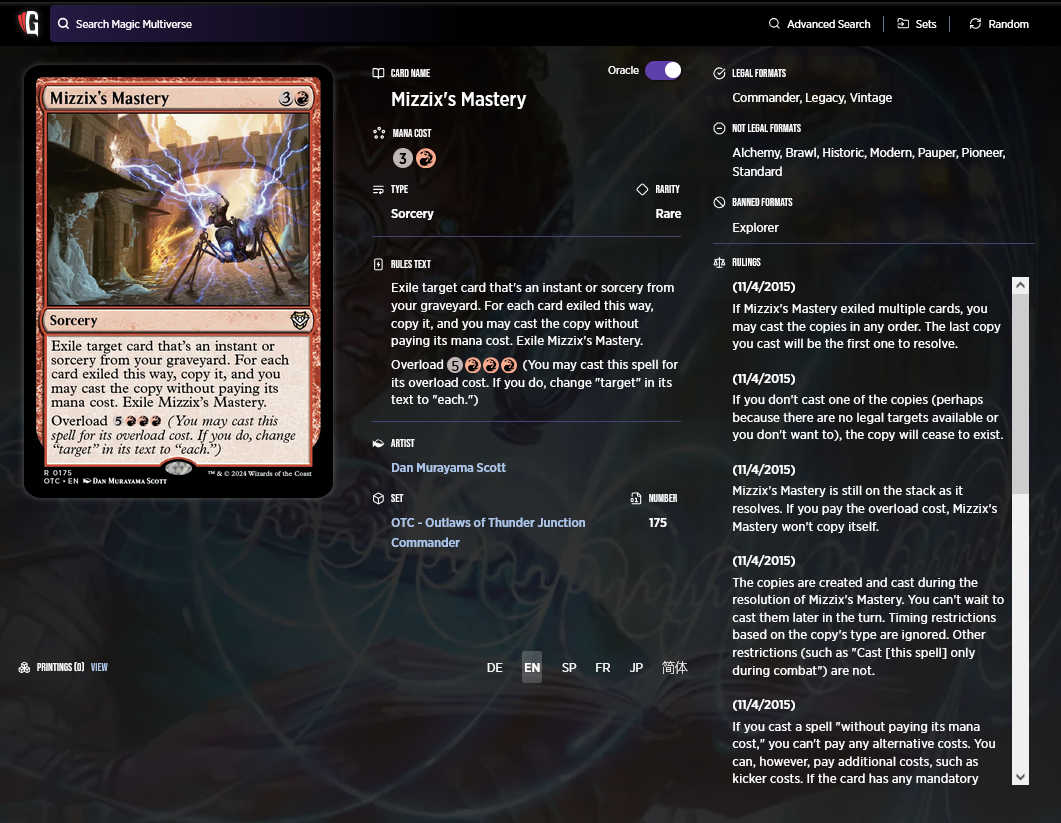
For example, older versions of Mizzix’s Mastery feature rulings explaining what happens with copies that are not cast (they cease to exist) and with their associated cards (they stay in exile); another ruling goes into more detail on which timing aspects are circumvented by the spell and which are not. The rulings for the new FINAL FANTASY Through the Ages version of Mizzix’s Mastery do not contain that information.
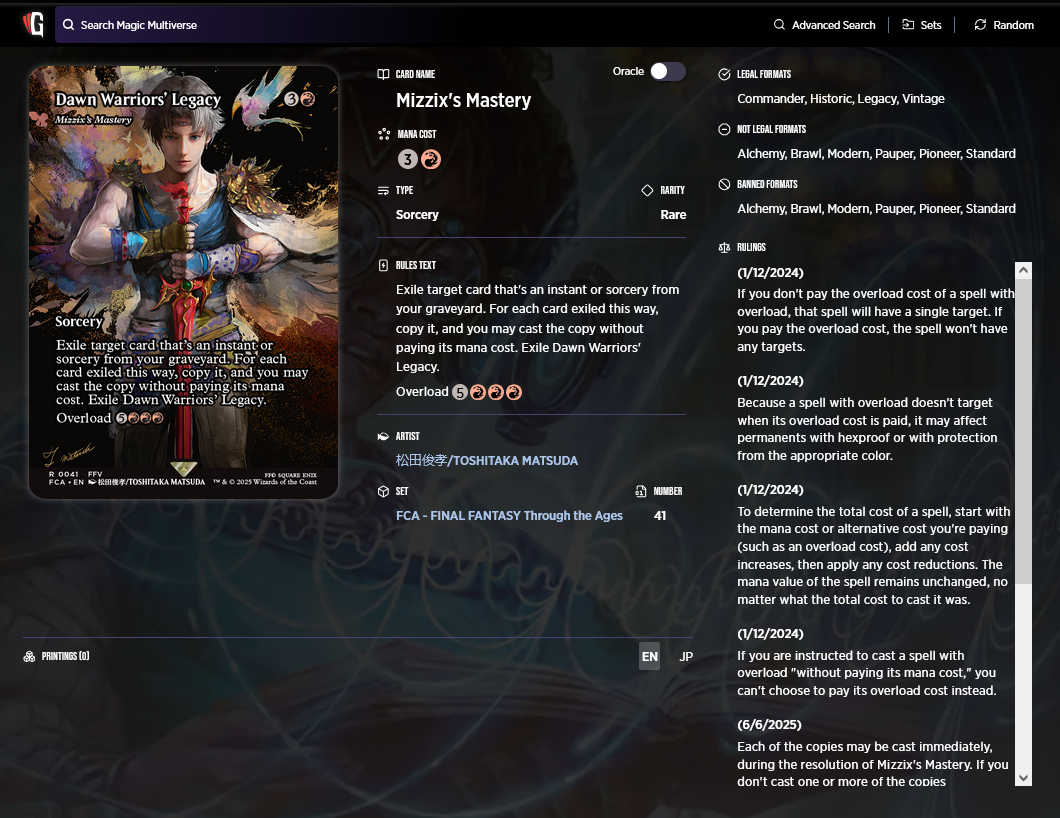
This update applies to: the Special Guests versions of Breeches, Brazen Plunderer, Dargo, the Shipwrecker, Malcolm, Keen-Eyed Navigator, Brazen Borrower, and Chandra’s Ignition, the Magic: The Gathering—FINAL FANTASY versions of Dark Confidant, the Magic: The Gathering—FINAL FANTASY Commander versions of Lingering Souls , Hypnotic Sprite, Murderous Rider, Tireless Tracker, Armory Automaton, Conqueror’s Flail and Lightning Greaves, and the FINAL FANTASY Through the Ages versions of Danitha Capashen, Paragon, Sram, Senior Edificer, Rhystic Study, Gix, Yawgmoth Praetor, Mizzix’s Mastery, Azusa, Lost but Seeking, Carpet of Flowers, Primeval Titan, Atraxa, Grand Unifier, Bruse Tarl, Boorish Herder, Ishai, Ojutai Dragonspeaker, Kinnan, Bonder Prodigy, Kraum, Ludevic’s Opus, Thrasios, Triton Hero, Tymna the Weaver, Vial Smasher the Fierce, Winota, Joiner of Forces, and Yuriko, the Tiger’s Shadow.
Preview for the upcoming “slash symbol”
WotC added a currently unannounced symbol to a few rulings containing a mana cost. The new symbol’s notation is “{/}”. WotC also added additional mana symbols to some of those rulings.
This update applies to: Jegantha, the Wellspring, Killer Cosplay, Omnath, Locus of All, Syndicate Heavy, Kellan, the Kid, Sorin of House Markov, Taeko, the Patient Avalanche, Hurska Sweet-Tooth, and Slinza, the Spiked Stampede.
“Fail to find” rulings
For a few cards, WotC moved a “fail to find” ruling to the start of the list.
This update applies to: Transmute Artifact, Oath of Lieges, Remembrance, Pattern of Rebirth, Bribery, Defiant Falcon, and Gaea’s Balance.
Reordered rulings for cards with text-changing effects which affect subtypes
Early cards with a text-changing effect that can affect subtypes (basic land types or creature types) share a list of rulings. WotC moved one of these rulings to a different place in the list, choosing different places for different cards (in the case of Artificial Evolution, they moved a card-specific ruling into the shared part). This makes comparing the rulings more engaging, since the order is slightly different from card to card.
This update applies to: Magical Hack, Mind Bend, Whim of Volrath, Crystal Spray, and Artificial Evolution.
Reordered rulings to match the rules text
WotC reordered the rulings of a few cards; the new order better matches the parts of the rules text they apply to.
This update applies to: Copy Artifact, Lich, and Zur’s Weirding.
Clockwork cards
For two Clockwork cards, WotC moved a ruling concerning the counter-adding ability to the start of the list. The corresponding ruling for the other Clockwork cards was not moved.
This update applies to: Clockwork Avian and Clockwork Swarm.
(Almost) duplicate rulings
To better reflect the “cast twice” nature of Lingering Souls, WotC duplicated the card’s rulings.
Since Dark Confidant’s ability is almost like drawing an additional card each turn, WotC added a ruling to the Magic: The Gathering—FINAL FANTASY versions that’s almost a duplicate of the existing ruling.
- Then again, WotC often omit minor changes in their own bulletins, so it’s par for the course. ↩︎
- Sometimes to the point of interchangeability: “Everything is just kicker or flashback.” ↩︎
- Just look at all the articles detailing the effort that went into Magic: The Gathering—FINAL FANTASY. WotC clearly aimed at making this the best Magic release ever. And why would they even develop a new Gatherer version if it was less functional than the previous one? ↩︎
- As per the guideline of “Don’t presume WotC made a mistake, especially if it seems like an obvious one.” ↩︎